Video distribution amplifiers make it easier to send one camera or switcher feed to multiple displays, recorders, monitors, or downstream production devices. The right model can simplify a live-streaming setup while preserving signal quality and connection reliability.
These 10 picks cover HDMI and SDI workflows, from compact four-output splitters to higher-density distribution solutions. Use the guide below to match output count, resolution, cabling, and signal type to your production needs.
Best 10 Video Distribution Amplifiers for Live Streaming Picks for 2026
Broadcast-Ready SDI Expansion
Blackmagic Design Mini Converter SDI Distribution

- Eight reclocked SDI outputs
- Auto-switches SD, HD, and 3G-SDI
- Supports embedded audio and ASI
Best For: Professional SDI live-event and broadcast distribution
Simple Analog Monitoring Split
AuviPal 1-to-4 BNC Video Splitter
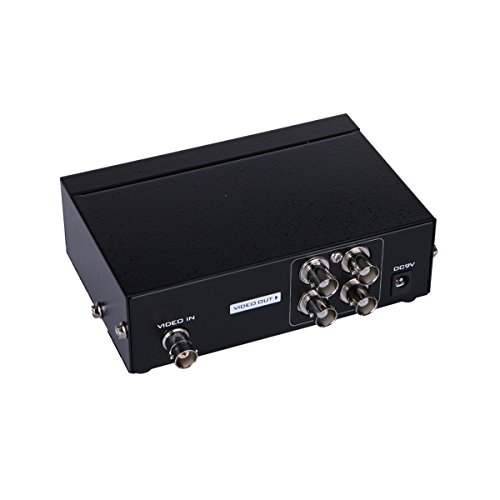
- One BNC input and four outputs
- Supports PAL, NTSC, and SECAM
- Plug-and-play metal housing
Best For: Analog CCTV and composite-video monitoring systems
Next-Gen HDMI Distribution
AC-DA14-AUHD-GEN2 HDMI 1 x 4 Amplifier

- 48 Gbps HDMI bandwidth
- Custom and extended EDID support
- Extracts digital or analog audio
Best For: HDMI 2.1b streaming and gaming-focused setups
Long-Run SDI Splitting
AVMATRIX SD1141 1×4 SDI Distribution Amplifier

- Auto-detects SD, HD, and 3G-SDI
- Reclocks all four outputs
- Supports long-distance transmission
Best For: Live production setups with extended SDI cable runs
Rack-Ready HDMI Control
1:16 HDMI Distribution Amplifier

- 16 HDMI distribution channels
- Includes splitter and rack ears
- Switches video and audio between sources
Best For: Rack-mounted HDMI live streaming and presentation systems
Long-Run SDI Reliability

- One input and nine SDI outputs
- Supports up to 1080p60 signals
- Reclocking supports extended cable runs
Best For: SDI live production and broadcast installations
4K Distribution Over Network Cable

- Extends HDMI to eight displays
- Includes eight independent receivers
- Supports 4K at 60 Hz up to 60 m
Best For: Multi-display installations using CAT5e/6 cabling
Compact BNC Splitter

- Distributes one video input to four outputs
- Uses BNC connectors
- Compact plastic design
Best For: Small analog video systems with BNC connections
Simple HDMI Distribution
Kramer VM-2H2 HDMI Distribution Amplifier

- Compact HDMI distribution unit
- Designed for audio or video use
- Weighs 14.1 ounces
Best For: Compact HDMI-based distribution setups
4K HDR HDMI Choice

- Supports up to 4K HDR HDMI signals
- Equalizes and reclocks the signal
- Routes one input to two outputs
Best For: Modern 4K HDR HDMI streaming workflows
Broadcast-Ready SDI Expansion – Blackmagic Design Mini Converter SDI Distribution
For demanding live streaming and broadcast workflows, the Blackmagic Design Mini Converter is one of the more capable video distribution amplifiers for live streaming. It accepts SD, HD, and 3G-SDI signals, automatically detects supported formats, and provides eight reclocked outputs for reliable signal distribution.
Best For: Live events, broadcast setups, and installations that need multiple SDI outputs with embedded audio or ancillary data support.
Pros:
- Distributes one SD/HD/3G-SDI input to eight reclocked outputs.
- Automatically switches among supported SD and HD formats.
- Supports embedded audio, ancillary data, and ASI signals.
- Includes a redundant SDI input for mission-critical use.
Cons:
- Uses SDI connectivity rather than HDMI or analog video connections.
- Requires a 12-volt power supply.
This is a strong choice when a streaming rig needs high output capacity and signal-management features. Its redundant input and broad format support make it especially suitable for professional environments where dependable distribution matters.
Simple Analog Monitoring Split – AuviPal 1-to-4 BNC Video Splitter
The AuviPal 4-port splitter is a straightforward option among video distribution amplifiers for live streaming when the source and displays use analog BNC video. It sends one input to four outputs, supports resolutions up to 1080p at 60Hz, and is designed for plug-and-play installation.
Best For: Analog CCTV, monitoring systems, and studio equipment using PAL, NTSC, or SECAM composite video.
Pros:
- Splits one BNC input across four BNC outputs.
- Supports up to 1080p at 60Hz according to the supplied specifications.
- Compact metal housing is designed for continuous operation and heat resistance.
- Includes a US power adapter, manual, and one-year warranty.
Cons:
- Not compatible with SDI or digital video signals.
- Requires cameras to be set to CVBS mode for compatibility.
- Limited to four outputs.
This splitter keeps analog distribution uncomplicated and affordable for compatible monitoring equipment. It is not the right fit for modern SDI or digital streaming chains, but it can work well in legacy or composite-video installations.
Next-Gen HDMI Distribution – AC-DA14-AUHD-GEN2 HDMI 1 x 4 Amplifier
The AC-DA14-AUHD-GEN2 targets HDMI 2.1-era installations that need to feed four displays or devices from one source. As video distribution amplifiers for live streaming, it stands out for its 48 Gbps bandwidth, custom EDID blending, and support for demanding next-generation display configurations.
Best For: HDMI 2.1b workflows, gaming-focused streaming setups, and installations requiring flexible EDID management and audio extraction.
Pros:
- Provides 48 Gbps bandwidth with Fixed Rate Link 6 support.
- Offers custom EDID blending and extended four-block EDID support.
- Supports HDMI 2.1b gaming-focused features.
- Can extract up to 7.1-channel digital or two-channel analog audio.
Cons:
- Provides four output channels, which may not suit larger distribution systems.
- Requires a 12-volt DC power supply.
This is the most feature-rich choice for newer HDMI-based streaming and display environments. Its EDID tools and audio extraction make it more flexible than a basic splitter, particularly when multiple display capabilities differ.
Long-Run SDI Splitting – AVMATRIX SD1141 1×4 SDI Distribution Amplifier
The AVMATRIX SD1141 is a practical pick among video distribution amplifiers for live streaming when SDI signals must travel over longer cable runs. It automatically detects SD, HD, and 3G-SDI, reclocks every output, and provides four outputs for cameras, monitors, recorders, or other SDI equipment.
Best For: Live production and event setups requiring four reclocked SDI outputs and extended transmission distances.
Pros:
- Accepts SD, HD, and 3G-SDI signals automatically.
- Reclocks all four outputs for stable signal transmission.
- Supports stated transmission distances up to 400m for SD, 200m for HD, and 120m for 3G-SDI.
- Includes a detachable bracket for wall mounting and a three-year warranty.
Cons:
- Uses SDI connectors and is not presented as an HDMI or analog solution.
- Outputs 2 and 4 support DVB-ASI, while the notes do not specify that feature for every output.
- Requires a 17-volt DC input.
For compact SDI systems with long cable paths, the SD1141 offers useful signal conditioning and installation flexibility. Its four-output design is less expansive than an eight-output unit, but the long-distance specifications and reclocking are valuable for event production.
Rack-Ready HDMI Control – 1:16 HDMI Distribution Amplifier
For live streaming setups that need to feed many HDMI destinations, this 1:16 HDMI distribution amplifier provides 16 channels in a rack-mount design. It also switches video and audio between sources without requiring physical access to the unit, which can simplify control-room operation.
Best For: Rack-mounted live streaming, presentation, and video systems requiring multiple HDMI outputs.
Pros:
- Provides 16 HDMI distribution channels.
- Includes the HDMI splitter and rack ears.
- Switches video and audio between sources remotely from the unit’s accessible controls.
- Designed for trouble-free connection with computers.
Cons:
- Its 21.7-inch width requires suitable rack or installation space.
- It is an HDMI-focused solution rather than an SDI distribution amplifier.
Choose this model when output count and rack integration matter most. Its large channel capacity is useful for centralized HDMI distribution, while the source-switching feature can reduce hands-on adjustments during a production.
Long-Run SDI Reliability – 3G/HD/SD SDI 1×9 Splitter
This SDI distribution amplifier is built for video distribution amplifiers for live streaming workflows that use SDI cabling. It accepts one auto-detected 3G-SDI, HD-SDI, or SD-SDI input and provides nine outputs, with reclocking and equalization to support longer cable runs.
Best For: Broadcast, live production, and control-room systems using SDI signals over extended cable distances.
Pros:
- Offers one input and nine outputs for SDI distribution.
- Supports signals up to 1080p at 60 Hz and 2.97 Gbps.
- Reclocks and equalizes outputs, with stated cable distances up to 120 m for 3G-SDI.
- Includes a detachable bracket for wall mounting and a 12V power adapter.
Cons:
- Uses SDI rather than HDMI connectors, so adapters may be needed for HDMI equipment.
- Its nine-output capacity is lower than a 16-output HDMI distribution unit.
- The supplied specifications list differing warranty durations.
The SD1191 is the stronger fit for SDI-centered installations where signal regeneration and cable length are priorities. Its compact wall-mountable design also suits production facilities, command centers, and other permanent video systems.
4K Distribution Over Network Cable – HDMI 1×8 Over CAT5e/6
For video distribution amplifiers for live streaming that need displays in different locations, this KanexPro system extends HDMI over a single CAT5e/6 cable to eight destinations. It includes eight independent receivers and supports UHD 4K at 60 Hz, with transmission distances up to 192 feet.
Best For: Live streaming, classroom, showroom, and event installations distributing one HDMI source to several remote displays.
Pros:
- Distributes HDMI to eight HD displays.
- Uses CAT5e/6 cabling for extension rather than individual long HDMI runs.
- Includes eight independent receivers.
- Supports UHD 4K at 60 Hz and distances up to 60 m.
Cons:
- Requires compatible receiver units at the display locations.
- The stated transmission distance is limited to 192 feet (60 m).
- Its eight-output design provides fewer destinations than a 16-channel HDMI amplifier.
This is a practical choice when displays are spread across a venue and existing CAT5e/6 infrastructure is easier to use than multiple HDMI cables. Confirm that the included receivers and 60 m distance fit the planned installation.
Compact BNC Splitter – Speco VIDDIST 1-in/4-out
Speco VIDDIST 1 in/4 Out Video Distribution Amplifier 1 Input to 4 Output Video Bnc Splitter
Check Price On AmazonFor straightforward analog video distribution, the Speco VIDDIST is a compact option among video distribution amplifiers for live streaming setups that use BNC connections. It accepts one video input and distributes it to four outputs, making it useful for sending the same feed to multiple compatible displays or devices.
Best For: Small analog video systems requiring one BNC input and four outputs.
Pros:
- 1-in/4-out configuration supports multiple destinations.
- Uses BNC connectors for compatible video equipment.
- Compact 4-1/2-inch-wide, 1-inch-high design.
- Lightweight plastic construction weighs 13.4 ounces.
Cons:
- Designed around BNC video connections rather than HDMI.
- Plastic construction may be less suited to demanding installations.
The VIDDIST is a practical fit when your distribution chain is BNC-based and you need four outputs from a single source. Confirm connector and signal compatibility before using it in a modern HDMI streaming workflow.
Simple HDMI Distribution – Kramer VM-2H2 HDMI Distribution Amplifier
The Kramer VM-2H2 is a compact HDMI distribution amplifier for routing one compatible source to multiple destinations. As one of the video distribution amplifiers for live streaming, it suits setups that need HDMI-based signal distribution in a small desktop or equipment-area footprint.
Best For: HDMI installations needing a compact distribution amplifier for multiple destinations.
Pros:
- Purpose-built for audio or video distribution.
- Compact 7.38-by-4.53-by-1-inch product dimensions.
- Lightweight design at 14.1 ounces.
- Package quantity is one unit.
Cons:
- The supplied notes do not specify supported resolution or output count.
- Compatibility details should be confirmed for your particular HDMI workflow.
This Kramer model is worth considering when a compact HDMI distribution unit fits your system requirements. Because the supplied specifications are limited, verify the exact input, output, and resolution capabilities before purchase.
4K HDR HDMI Choice – Kramer VM-2H2 1:2 4K HDR
Kramer 10-804080190 VM-2H2 is A 1:2 Distribution Amplifier for UP to 4K HDR, HDMI Signals That COMPL
Check Price On AmazonThe Kramer VM-2H2 is a 1:2 HDMI distribution amplifier designed for signals up to 4K HDR. For live streaming systems using modern HDMI sources, it accepts one input, equalizes and reclocks the signal, then sends it to two identical outputs while supporting HDMI 2.0 and HDCP 2.2.
Best For: 4K HDR HDMI workflows that need one source routed to two outputs.
Pros:
- Supports signals up to 4K HDR.
- Compatible with HDMI 2.0 signals and HDCP 2.2 content protection.
- Equalizes and reclocks the HDMI signal.
- Provides two identical outputs from one HDMI input.
Cons:
- Offers two outputs, which may be limiting for larger distribution networks.
- The supplied listing states that no warranty is included.
- Requires a 5-volt power supply.
With 4K HDR support and signal reclocking, this VM-2H2 is the most clearly specified choice here for a current HDMI streaming environment. Its 1:2 layout is best when you only need two destinations rather than a larger output count.
How We Picked the Best Video Distribution Amplifiers for Live Streaming
We focused on distribution amplifiers that suit common live-production tasks: duplicating a camera, switcher, or playback signal for several destinations. The selection includes HDMI and SDI units, different output counts, and options for short direct connections as well as longer cable runs.
Key considerations included supported video standards, input and output configuration, connector type, signal integrity, installation practicality, and suitability for monitoring, recording, venue displays, or streaming control rooms. A distribution amplifier does not replace a video switcher or scaler, so compatibility with the rest of your system remains essential.
Quick Comparison
| Best For | Recommended Type | What to Check |
|---|---|---|
| Small HDMI streaming rigs | 1:2 or 1:4 HDMI amplifier | Resolution, HDR, HDCP, and output count |
| Multiple HDMI destinations | 1:8 or 1:16 HDMI amplifier | Bandwidth, cooling, and installation space |
| Professional camera and broadcast systems | SDI distribution amplifier | SD, HD, or 3G-SDI support and BNC compatibility |
| Long cable runs | SDI or HDMI-over-CAT solution | Required cable category, distance, and receiver hardware |
| CCTV or analog video systems | BNC video splitter/amplifier | Video format, impedance, and connector standards |
Key Buying Factors for Video Distribution Amplifiers for Live Streaming
Signal Type and Compatibility
Start by identifying whether your source uses HDMI, SDI, or analog composite video. HDMI models are common with consumer and prosumer cameras, laptops, and streaming switchers. SDI models are generally better suited to professional cameras and longer cable runs. An amplifier must support the source’s resolution and frame rate; a 3G-SDI unit, for example, is not automatically suitable for every newer high-bandwidth format.
Output Count and Expansion
Choose enough outputs for current destinations plus reasonable expansion. A 1:4 unit works well for a camera monitor, recorder, confidence display, and encoder. Larger 1:8 or 1:16 models make more sense for venues, classrooms, control rooms, and multi-display installations. Avoid paying for excess outputs if a compact setup is all you need.
Resolution, HDR, and Protection Features
For HDMI, verify maximum resolution, refresh rate, HDR support, and HDCP behavior. The amplifier should match the capabilities of the source and every connected display or device. EDID handling can also affect whether the source establishes a stable signal when outputs have different capabilities.
Cabling and Installation
HDMI is convenient but distance-sensitive, especially at higher resolutions. SDI can be more practical for long runs using quality coaxial cable. HDMI-over-CAT models may reduce cabling costs, but they typically require compatible receivers or a suitable infrastructure. Also check rack mounting, power requirements, ventilation, and status indicators.
Who Should Buy Which Video Distribution Amplifiers for Live Streaming?
Choose HDMI for Most Small Streaming Studios
HDMI distribution amplifiers are a practical choice for creators using HDMI cameras, switchers, computers, and consumer displays. Select a four-output model for a compact studio and a higher-output model when several monitors or recorders must receive the same feed.
Choose SDI for Professional Production
SDI is the better fit for broadcast-style cameras, production trucks, event venues, and installations that need robust BNC connections and longer cable runs. Match the amplifier to the exact SDI standard used by your equipment.
Choose CAT-Based Distribution for Structured Installations
HDMI distribution over CAT5e or CAT6 can suit classrooms, conference rooms, houses of worship, and venues where centralized equipment must connect to distant displays. Confirm the required receiver hardware and supported distance before buying.
Choose Analog BNC for Legacy or Security Systems
For older composite-video monitoring and CCTV equipment, an analog BNC splitter or distribution amplifier may be the most compatible option. These products are not interchangeable with HDMI or SDI devices, so confirm the source format before ordering.