Building a home studio often means sending one camera or playback signal to several displays, recorders, monitors, or capture devices. The right distribution amplifier preserves signal quality while making your setup easier to expand.
These 10 options cover composite video, analog audio/video, SDI, and higher-bandwidth studio workflows. Use the guide below to narrow your choice by format, output count, signal distance, and installation needs.
Best 10 Video Distribution Amplifiers for Home Studios Picks for 2026
SDI Signal Hub
Blackmagic Design Mini Converter

- Eight re-clocked SDI outputs
- Auto-switches SD, HD, and 3G-SDI
- Supports embedded audio and ancillary data
Best For: SDI-based home studios and multi-device signal routing
Analog BNC Splitter
AuviPal 4-Port Video Distributor
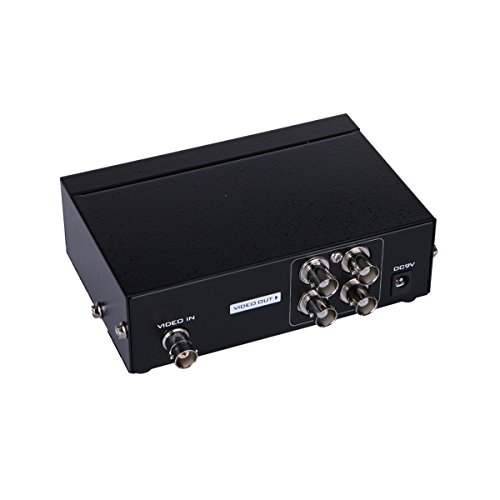
- One BNC input feeds four outputs
- Supports PAL, NTSC, and SECAM
- Plug-and-play metal enclosure
Best For: Analog composite video monitoring and CCTV systems
Composite A/V Duplicator
DTECH Powered 8-Way RCA Splitter

- One 3-RCA input feeds eight outputs
- Amplified analog video and stereo audio
- Metal case with LED and color-coded jacks
Best For: Analog composite A/V duplication and dubbing projects
Compact SDI Repeater

- Four buffered HD-SDI/SDI outputs
- Automatic equalization
- Compact surface-mount design
Best For: Small home studios distributing one SDI source to four destinations
Powered RCA Splitter

- One 3-RCA input to four outputs
- Built-in RCA signal amplifier
- Includes 9V AC adapter
Best For: Analog composite video and stereo audio distribution
4K SDI Distribution Hub

- One SDI input to eight outputs
- Supports 12G and 4K SDI
- LED signal-lock and rate indicators
Best For: Multi-destination SDI and 4K home studio systems
Compact Analog Choice
RDL FP-VDA4 1x4 Video Distribution Amplifier
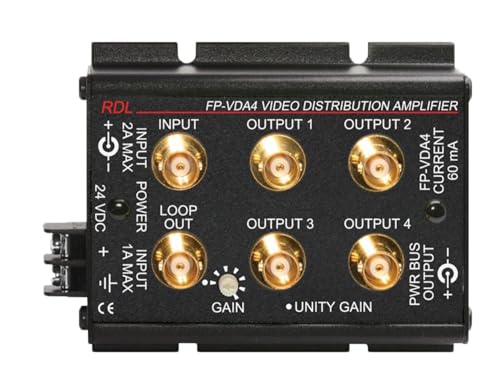
- Four video outputs from one input
- Supports NTSC and PAL
- Includes input loop-out jack
Best For: Compact NTSC/PAL home studio setups
Long-Run SDI Pick
AVMATRIX SD1141 3G/HD/SD SDI Splitter

- Supports 3G/HD/SD-SDI up to 1080p60
- Reclocks all four outputs
- Transmission distances up to 400m for SD
Best For: SDI studios with longer cable runs
Five-Output A/V Option
AV501HD 1-In 5-Out Distribution Amplifier
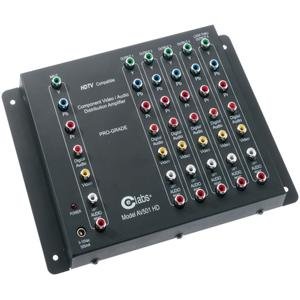
- One input and five output channels
- Surface-mount design
- Useful when four outputs are not enough
Best For: Installations needing five distribution outputs
SDI Signal Hub – Blackmagic Design Mini Converter
For home studios built around SDI equipment, the Blackmagic Design Mini Converter is a flexible choice among video distribution amplifiers for home studios. It accepts SD, HD, and 3G-SDI signals, automatically switches formats, and provides eight re-clocked outputs for sending one source to multiple devices.
Best For: SDI-based home studios, live-event setups, and installations that need multiple stable outputs with embedded audio or ancillary data.
Pros:
- Distributes one SD/HD/3G-SDI input to eight re-clocked outputs.
- Supports automatic switching across a broad range of SD and HD formats.
- Handles ASI, ancillary data, and embedded audio.
- Includes a redundant SDI input for more critical applications.
Cons:
- Designed for SDI workflows rather than analog BNC, RCA, or general consumer video systems.
- Requires a 12-volt power supply.
Its eight outputs and format flexibility make it the strongest fit here for a professional SDI home studio. Choose it when re-clocked SDI distribution matters more than simple plug-and-play analog splitting.
Analog BNC Splitter – AuviPal 4-Port Video Distributor
The AuviPal 4-Port BNC Video Splitter is a straightforward option among video distribution amplifiers for home studios using analog composite video. Its powered design sends one BNC input to four outputs and supports resolutions up to 1080p at 60Hz when used with compatible analog formats.
Best For: Analog CCTV, monitoring, and studio systems that need to feed up to four BNC-compatible displays or devices.
Pros:
- Splits one BNC input to four simultaneous outputs.
- Supports PAL, NTSC, and SECAM analog formats.
- Metal housing is designed for continuous operation and heat resistance.
- Includes a US power adapter, user manual, and one-year warranty.
Cons:
- Not compatible with SDI or digital signals.
- Requires connected cameras or sources to use CVBS mode.
This is a practical, compact solution for analog BNC distribution, especially in monitoring-oriented setups. It is not the right match for a modern SDI workflow, but it keeps four-way composite splitting simple.
Audio Distribution Companion – Rolls DA134 4-Channel Amplifier
The Rolls DA134 is an audio-focused distribution amplifier for home studios that need to share a stereo or mono source across four channels. Front-panel volume controls, stereo pass-through, and support for direct inputs from an iPad, iPod, or laptop make it useful alongside video routing gear in a compact studio system.
Best For: Home studios distributing line-level stereo or mono audio to four channels, headphones, or connected monitoring paths.
Pros:
- Provides four-channel stereo or mono distribution.
- Offers front-panel volume controls.
- Accepts inputs from an iPad, iPod, or laptop.
- Includes stereo pass-through for connecting another DA134.
Cons:
- It is an audio distribution amplifier, not a video signal splitter.
- The listed warranty is 90 days.
Although it does not distribute video itself, the DA134 can complement video distribution amplifiers for home studios by handling the associated line-level audio. Consider it when your setup needs flexible four-channel audio routing in a small metal enclosure.
Composite A/V Duplicator – DTECH Powered 8-Way RCA Splitter
The DTECH Powered 8-Way RCA Splitter is designed for analog composite A/V systems that need one source duplicated across eight destinations. As one of the video distribution amplifiers for home studios, it combines yellow video and red/white stereo-audio routing in a powered metal box suited to monitors, projectors, capture devices, and dubbing setups.
Best For: Home theaters, dubbing projects, and analog studios distributing one composite video and stereo audio source to eight devices.
Pros:
- Splits one 3-RCA input into eight 3-RCA outputs.
- Built-in amplification supports longer-distance connections.
- Works with TVs, projectors, receivers, capture cards, consoles, and recorders.
- Includes a 9V power adapter, LED indicator, and color-coded RCA jacks.
Cons:
- Limited to analog composite RCA video and stereo audio connections.
- Requires AC power for active signal distribution.
For a studio centered on legacy composite equipment, this DTECH unit offers more destinations than a basic passive splitter and keeps audio and video together. It is best selected when your sources and displays use RCA rather than SDI or digital connections.
Compact SDI Repeater – AJA HD5DA
For home studios using SDI equipment, the AJA HD5DA is a compact choice among video distribution amplifiers for home studios. It accepts an HD-SDI or SDI signal and provides four separately buffered outputs, with automatic equalization and multi-standard operation.
Best For: Home studios that need to distribute one SDI source to four displays or downstream devices.
Pros:
- Four independently buffered HD-SDI/SDI outputs
- Automatic equalization helps support signal distribution
- Can act as a low-cost repeater
- Compact surface-mount design
Cons:
- Provides four outputs rather than eight
- Designed for SDI video distribution, not RCA composite connections
- Requires a 5V DC power supply
The HD5DA is a focused solution for smaller SDI setups. Its four buffered outputs and repeater function make it practical when a studio needs reliable one-to-four signal distribution without a larger chassis.
Powered RCA Splitter – DTECH 4-Way Composite A/V
The DTECH FJ104-US is a practical option for home studios that use analog gear and need video distribution amplifiers for home studios. Its powered 3-RCA design splits one composite video and stereo audio input to four outputs for TVs, monitors, speakers, or dubbing setups.
Best For: Analog home studios, gaming setups, and video dubbing projects using composite RCA connections.
Pros:
- Distributes one 3-RCA input to four outputs
- Built-in signal amplification supports longer connections
- Color-coded RCA ports and LED indicator simplify setup
- Includes a 9V AC power adapter
Cons:
- Limited to composite video and standard stereo RCA audio
- Requires AC power for operation
- Does not include switching between multiple sources
With its metal housing, anti-skid feet, and compact form, the DTECH splitter is easy to place behind a monitor or in a rack. It is best suited to analog distribution rather than modern SDI or digital-video workflows.
4K SDI Distribution Hub – VP-901 1×8 12G SDI
The VP-901 is built for larger SDI installations and stands out among video distribution amplifiers for home studios with 12G-SDI or 4K workflows. It amplifies one 12G, 4K, HD, or SD-SDI input to eight outputs while supporting embedded audio and automatic data-rate detection.
Best For: Home studios that need to send one SDI source to up to eight destinations, including 4K-capable setups.
Pros:
- Distributes one SDI input to eight outputs
- Supports 12G, 4K, HD, and SD-SDI formats
- Equalization and re-clocking enhance signal handling
- LEDs show signal lock and video rate
Cons:
- Designed specifically for SDI connections
- Eight-output capacity may be more than smaller studios need
- Supplied notes do not specify included accessories or power requirements
The VP-901 is the strongest fit here for high-output SDI distribution. Its format flexibility, re-clocking, and eight outputs make it a useful central distribution point for a studio with multiple SDI endpoints.
Compact Analog Choice – RDL FP-VDA4 1×4 Video Distribution Amplifier
For home studios using NTSC or PAL sources, the RDL FP-VDA4 is a straightforward option among video distribution amplifiers for home studios. It accepts one video input, provides four outputs, and includes an input loop-out jack for passing the source onward.
Best For: Home studios that need four-way NTSC/PAL distribution in a compact surface-mount unit.
Pros:
- Provides four video outputs from one input.
- Supports both NTSC and PAL operation.
- Includes an input loop-out jack.
- Compact 4 x 3 x 1-inch design.
Cons:
- Limited to four output channels.
- Designed for NTSC/PAL video rather than the SDI formats listed for newer digital systems.
The FP-VDA4 is a practical fit when compatibility with NTSC or PAL matters more than a large output count. Its loop-out connection and small footprint make it easy to integrate into a compact analog setup.
Long-Run SDI Pick – AVMATRIX SD1141 3G/HD/SD SDI Splitter
The AVMATRIX SD1141 is built for SDI-based video distribution amplifiers for home studios, with one input and four outputs supporting 3G, HD, and SD-SDI signals. Automatic signal detection, output reclocking, and stated transmission distances make it suited to longer cable runs.
Best For: SDI home studio systems requiring four outputs and extended 3G/HD/SD-SDI transmission.
Pros:
- Supports SDI video up to 1080p at 60 Hz.
- Automatically detects HD, SD, and AG-SDI signals.
- Reclocks all outputs for signal transmission over longer runs.
- Includes a detachable wall-mounting bracket.
Cons:
- Uses SDI connectors, so it is not intended for analog NTSC/PAL distribution.
- Requires a 17-volt DC input.
- Only four outputs are provided.
Choose the SD1141 when your studio is centered on SDI and cable distance is a priority. Its compact enclosure, wall-mounting option, and reclocking support provide useful installation flexibility.
Five-Output A/V Option – AV501HD 1-In 5-Out Distribution Amplifier
The AV501HD offers a simple five-channel format for home studios comparing video distribution amplifiers for home studios. Its supplied specifications identify one input and five outputs in a surface-mount design, making it a candidate when you need one additional feed beyond a typical four-output unit.
Best For: Surface-mounted studio installations needing five A/V distribution channels.
Pros:
- Provides five output channels.
- Uses a surface-mount configuration.
- Offers a simple one-input, five-output layout.
Cons:
- Supplied notes do not specify connector type or supported video standards.
- Supplied notes do not provide dimensions or signal-distance ratings.
The AV501HD is worth considering when its five-output capacity matches your distribution plan. Because the available specifications are limited, confirm connector compatibility and video-format requirements before purchasing.
How We Picked the Best Video Distribution Amplifiers for Home Studios
We grouped these Video Distribution Amplifiers for Home Studios by signal format, output capacity, connectivity, and likely use case. The lineup includes composite video and audio splitters for legacy equipment, analog BNC distribution amplifiers, and SDI models for cameras, switchers, monitors, and capture systems.
Priority goes to products that clearly identify their input and output configuration, support common studio signal standards, and provide a practical way to distribute one source without relying on unpowered passive splitting. Compatibility matters as much as output count: a 3G/HD/SDI unit is not interchangeable with a composite RCA splitter, even if both are described as video distributors.
Quick Comparison
| Best For | Look For | Typical Connection |
|---|---|---|
| Legacy TVs, DVD players, and game consoles | Composite video and stereo audio outputs | RCA |
| Analog CCTV or monitor systems | BNC connectors and NTSC/PAL support | BNC coaxial |
| Modern camera and broadcast workflows | SD, HD, 3G, or 12G SDI compatibility | 75-ohm BNC |
| Small home studios | Four or five outputs with a compact enclosure | RCA, BNC, or SDI |
| Larger multi-display setups | Eight outputs and adequate signal bandwidth | RCA or SDI |
Key Buying Factors for Video Distribution Amplifiers for Home Studios
Match the Signal Format
Start with the source and destination connectors. RCA models are intended for composite video, often with left and right analog audio. BNC distribution amplifiers may handle analog NTSC/PAL or digital SDI, but the standards are not automatically compatible. Confirm the exact format before ordering.
Check Resolution and Data Rate
For SDI systems, select a unit rated for your highest signal requirement. SDI, HD-SDI, 3G-SDI, and 12G-SDI represent different bandwidth levels. Choosing a model with headroom can help support future cameras or switchers, but it will not convert one signal type into another.
Count Outputs and Consider Cabling
Choose enough outputs for current displays plus reasonable expansion. Four outputs suit many desk-based studios, while eight-output models are better for control rooms or multiple monitoring positions. Use suitable 75-ohm cable, especially for BNC and SDI connections, and account for cable length when planning the installation.
Consider Audio and Power
If your setup distributes sound as well as picture, verify that the amplifier carries the required audio channels. Powered units generally provide more reliable distribution than passive splitters. Also check the included power adapter, enclosure size, ventilation, and whether the product is designed for continuous operation.
Who Should Buy Which Video Distribution Amplifiers for Home Studios?
Choose a composite RCA distributor if your studio uses older game consoles, DVD players, VCRs, or standard-definition televisions. Pick an analog BNC model for legacy CCTV, NTSC/PAL monitoring, or other coaxial video systems. For cameras, switchers, and professional monitors using SDI, choose an SDI distribution amplifier rated for the required SD, HD, 3G, or 12G signal.
If you need a simple, affordable way to feed several nearby displays, prioritize a compact four- or five-output model. Choose an eight-output unit when multiple rooms, monitors, or recording devices must receive the same source. The best option is the one that matches your signal standard exactly, provides enough outputs, and leaves a manageable path for future expansion.