The best soundbars for home studios can simplify a compact listening setup without the wiring and space demands of a traditional speaker system. The right model can improve clarity for editing, streaming, presentations, and casual music production.
This roundup compares compact 2.0 bars, subwoofer-equipped systems, and immersive Dolby Atmos options, with attention to connectivity, size, bass control, and practical studio use.
Best 10 Soundbars for Home Studios Picks for 2026
Best Immersive Upgrade

- Wireless subwoofer for deep bass
- Dolby Atmos, DTS Virtual:X, and room calibration
- HDMI eARC/ARC, optical, Bluetooth, and AUX
Best For: Small-to-medium studio rooms needing versatile, bass-rich audio
Best Compact Simplicity

- Slim, wall-mountable design
- Voice enhancement for clearer dialogue
- Bluetooth and HDMI ARC connectivity
Best For: Small studios wanting an uncomplicated, space-saving upgrade
Best Budget Bass Package
Saiyin Sound Bar with Subwoofer
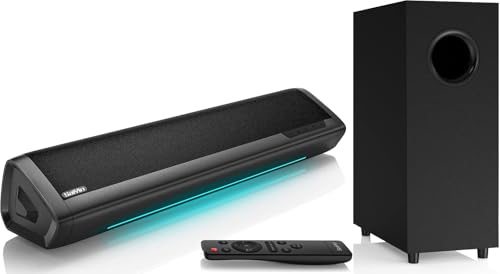
- Dedicated subwoofer for punchier bass
- Bluetooth, optical, and auxiliary inputs
- Three EQ modes and included connection cables
Best For: Budget setups connecting a computer, TV, and music sources
Best Fire TV Companion

- Compact 24-inch design
- Dolby Audio and DTS Virtual:X
- HDMI eARC/ARC and Bluetooth
Best For: Fire TV users with compact studio-media setups
Compact Value Pick
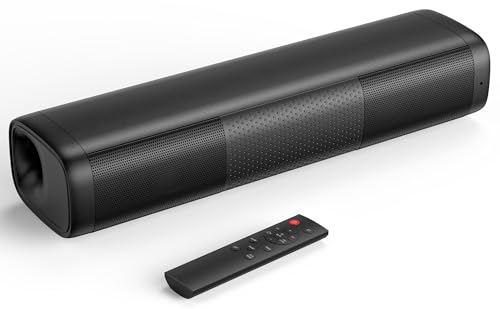
- 11.7-inch design for tight spaces
- Bluetooth 5.3, optical, and auxiliary inputs
- Dedicated output for a powered subwoofer
Best For: Small desks and flexible stereo setups
Dialogue-Focused Choice

- Dialogue mode emphasizes vocals
- Bluetooth, HDMI-ARC, optical, and AUX inputs
- Compact stereo design with angled drivers
Best For: Clear speech and simple desktop entertainment setups
Immersive Studio Room Pick

- 5.1-channel Dolby Atmos sound
- 300W peak output with wired subwoofer
- App EQ with 10-band controls and 121 presets
Best For: Larger rooms, gaming, and cinematic playback
Deep-Bass Pick

- 300W maximum system output
- Wireless 6.5-inch subwoofer
- Bluetooth, HDMI, and optical connectivity
Best For: Entertainment-focused home studios needing powerful bass
Flexible Budget Pick
Assistrust KY-8000 Detachable Soundbar

- Detachable, multi-placement design
- 80W output with three EQ modes
- Bluetooth, ARC, optical, and AUX inputs
Best For: Compact studios and versatile desktop setups
Immersive Premium Pick

- 750W system with wireless 10-inch subwoofer
- Dolby Atmos and MultiBeam 3.0
- Room calibration and HDMI eARC
Best For: Large studios prioritizing cinematic playback and powerful bass
Best Immersive Upgrade – TCL S55H 2.1 Sound Bar
For home studios that also serve as media rooms, the TCL S55H is a feature-rich choice among soundbars for home studios. Its wireless subwoofer, Dolby Atmos, DTS Virtual:X, and AI Sonic room calibration support a fuller, more adaptable listening setup.
Best For: Small-to-medium rooms, movie and gaming playback, and users who want strong bass without running speaker cables across the room.
Pros:
- Wireless subwoofer adds deep, punchy bass while keeping the soundbar focused on dialogue and mids.
- Dolby Atmos, DTS Virtual:X, and AI Sonic auto room calibration provide an immersive, layout-aware presentation.
- Supports HDMI eARC/ARC, optical, Bluetooth, and AUX, with app and remote control.
- Includes an HDMI cable, remote, batteries, and wall-mount kit.
Cons:
- The separate subwoofer requires additional floor or shelf space.
- Its 2.1-channel design is aimed at virtual immersion rather than discrete surround speakers.
The S55H stands out when you want convenient connectivity, room calibration, and cinematic bass in one package. It is a particularly practical fit for a compact studio that doubles as an entertainment space.
Best Compact Simplicity – Sony S100F 2.0ch Soundbar
The Sony S100F is a straightforward option for soundbars for home studios where space and setup simplicity matter. Its slim 2.0-channel design adds clearer TV and Bluetooth audio without requiring a separate subwoofer.
Best For: Small studios, desks or living spaces with limited room, and listeners who prioritize simple connections and improved dialogue.
Pros:
- Compact, slim design suits small living spaces and can be wall-mounted.
- Voice enhancement helps make quiet dialogue and conference-call participants easier to hear.
- Bluetooth and HDMI ARC provide convenient wireless and TV connectivity.
- S-Force Pro Front Surround creates a wider virtual presentation from the single bar.
Cons:
- The 2.0-channel system does not include a dedicated subwoofer.
- Connectivity is less extensive than models offering multiple wired inputs.
The S100F is best viewed as a clean, no-fuss upgrade for a compact setup. It favors intelligibility and convenience over the deep bass or expanded connectivity of larger systems.
Best Budget Bass Package – Saiyin Sound Bar with Subwoofer
The Saiyin sound bar pairs a dedicated subwoofer with practical input options, making it a flexible value pick among soundbars for home studios. Its three EQ modes and included cables help simplify setup for a TV, computer, or other source.
Best For: Budget-conscious studio users who want dedicated bass, basic surround-style playback, and compatibility with computers or televisions.
Pros:
- Dedicated subwoofer delivers fuller, punchier bass than a standalone compact bar.
- Bluetooth, optical, and auxiliary inputs support computers, phones, TVs, and other devices.
- Three equalizer modes let you tailor playback for news, movies, or music.
- Includes optical and auxiliary cables, mounting hardware, and a remote.
Cons:
- The subwoofer must be connected to the soundbar’s SUB OUT port rather than AUX IN.
- The supplied notes describe stereo output, so it is not a discrete multichannel system.
- The remote is not compatible with universal or TV remotes, though Fire TV remote compatibility is noted.
Choose the Saiyin when a low-cost, all-in-one package and dedicated bass are more important than advanced formats. Its broad basic connectivity makes it useful in mixed PC-and-TV studio setups.
Best Fire TV Companion – Amazon Fire TV Soundbar
Amazon Fire TV Soundbar, 2.0 speaker with DTS Virtual:X and Dolby Audio, Bluetooth connectivity
Check Price On AmazonThe Amazon Fire TV Soundbar is a compact, uncomplicated choice for soundbars for home studios that also use a Fire TV device. Dual speakers, Dolby Audio, DTS Virtual:X, and HDMI eARC/ARC support deliver a more substantial TV and streaming experience in a short enclosure.
Best For: Fire TV users and compact studios that need clearer dialogue, Bluetooth music streaming, and a soundbar that fits beneath most displays.
Pros:
- Compact 24-inch-wide, 2.5-inch-high design fits most entertainment consoles and TV stands.
- Dolby Audio and DTS Virtual:X provide fuller sound and virtual three-dimensional effects.
- HDMI eARC/ARC setup is designed for synchronized TV audio.
- Bluetooth supports music streaming from a phone or tablet, with Fire TV remote integration.
Cons:
- The 2.0 speaker design does not include a dedicated subwoofer.
- Power adapter and cable are not included according to the supplied notes.
- It is optimized around TV and streaming use rather than detailed studio-monitoring features.
The Fire TV Soundbar makes sense when compact dimensions and ecosystem convenience are priorities. It is a practical media-focused addition to a small studio, especially for Fire TV households.
Compact Value Pick – Saiyin 48W Compact Sound Bar
For shoppers comparing soundbars for home studios, the Saiyin 11.7-inch model is a practical choice when desk space is limited. Its stereo output, 48W peak power, and Bluetooth 5.3, optical, and auxiliary inputs make it suitable for a computer, TV, smartphone, or gaming setup.
Best For: Small desks, compact monitoring setups, and buyers who want flexible wired and wireless connections.
Pros:
- Compact 11.7-inch design fits under screens or on narrow shelves.
- Offers Bluetooth 5.3, optical, and 3.5mm auxiliary connectivity.
- Dedicated subwoofer output allows a powered subwoofer upgrade.
- Includes a remote, optical cable, auxiliary cable, and wall-mounting hardware.
Cons:
- It provides two-channel stereo rather than surround sound.
- Optical playback requires the source to be set to PCM, stereo, or non-surround output.
The Saiyin is best viewed as a space-saving stereo soundbar rather than a full studio-monitor replacement. It makes sense for everyday desktop audio and small-room listening, especially if you value simple connections and the option to add more bass later.
Dialogue-Focused Choice – Bose TV Speaker
Among soundbars for home studios, the Bose TV Speaker is a straightforward option for listeners who prioritize clear vocals and uncomplicated setup. Its two angled full-range drivers, stereo output, Bluetooth, HDMI-ARC, optical, and AUX connectivity cover common desktop and entertainment applications.
Best For: Voice-focused listening, compact rooms, and users who prefer a simple, polished all-in-one soundbar.
Pros:
- Dialogue mode is designed to enhance speech clarity.
- Two angled drivers create a wider, more natural stereo presentation.
- Supports Bluetooth plus HDMI-ARC, optical, and AUX connections.
- Compact 2.21-inch height supports placement in front of a screen or wall mounting.
Cons:
- HDMI cable and wall brackets are sold separately.
- It is a stereo soundbar, not a surround or Dolby Atmos system.
- A compatible Bose Bass Module requires a separate purchase and connection cable.
The Bose TV Speaker suits a home studio that doubles as a media space and needs intelligible speech without a complicated speaker package. Its compact form and broad input selection are useful, though listeners seeking deep bass or immersive surround will need a larger system.
Immersive Studio Room Pick – ULTIMEA Poseidon M60
For larger home studios and media rooms, the ULTIMEA Poseidon M60 brings a more expansive approach to soundbars for home studios. Its 5.1-channel Dolby Atmos design, wired wooden subwoofer, HDMI eARC, app-based equalizer, and 300W peak output are aimed at room-filling playback rather than minimal desktop audio.
Best For: Larger rooms, cinematic listening, gaming, and users who want extensive sound-shaping controls.
Pros:
- 5.1-channel Dolby Atmos system uses five built-in speakers and side-firing drivers.
- 300W peak output and a wired 5.25-inch subwoofer provide substantial room-filling sound.
- HDMI eARC supports lossless Dolby Atmos audio, with CEC for unified control.
- App offers a 10-band EQ, 121 presets, adjustable surround levels, and OTA updates.
Cons:
- The separate wired subwoofer requires more space and cable management.
- Its feature set and larger output may be excessive for a small desk or nearfield setup.
- It is not waterproof and is intended for indoor use.
The Poseidon M60 is the strongest fit here when a home studio also serves as a theater or gaming room. Its extensive tuning controls can help tailor playback, but the larger 5.1 system is less convenient than a compact stereo bar for close-range desk listening.
Deep-Bass Pick – JBL Bar 2.1 Deep Bass
For shoppers comparing soundbars for home studios, the JBL Bar 2.1 Deep Bass (MK2) is a straightforward 2.1-channel option with substantial output, wireless bass, and simple wired or Bluetooth connections. Its emphasis is on room-filling playback rather than detailed studio monitoring.
Best For: Home studios that double as movie, music, gaming, or general entertainment spaces.
Pros:
- 300W maximum system output supports powerful room-filling sound.
- Wireless 6.5-inch subwoofer adds deep bass without a subwoofer cable.
- Supports Bluetooth streaming plus HDMI and optical connections.
- Built-in Dolby Digital and JBL Surround Sound enhance TV and movie playback.
Cons:
- The 2.1-channel design is less flexible for multichannel studio layouts.
- Its bass-forward presentation may not suit critical mixing or neutral monitoring.
- The system is relatively large and weighs 22 pounds.
This JBL makes the most sense when you want a convenient entertainment soundbar with strong bass in a studio room. For accurate production decisions, pair it with dedicated nearfield monitors rather than relying on it as the only reference.
Flexible Budget Pick – Assistrust KY-8000 Detachable Soundbar
Among soundbars for home studios, the Assistrust KY-8000 stands out for its compact, detachable design and broad connection selection. Its 80W output, automatic volume boost, and three listening modes make it adaptable for desktop, TV, gaming, and projector setups.
Best For: Small or flexible home studios where placement options and simple device compatibility matter.
Pros:
- Detachable design supports horizontal, vertical, tabletop, or wall-mounted placement.
- Bluetooth 5.0, ARC, optical, and AUX inputs cover common studio and entertainment devices.
- Three equalizer modes target movie, music, and news listening.
- Automatic volume boost is designed to make quieter sounds more noticeable.
Cons:
- Its 80W output is substantially lower than the larger JBL systems in this roundup.
- It has stereo two-channel output rather than surround processing.
- The supplied remote does not include batteries.
The KY-8000 is a practical choice when a home studio needs one adaptable speaker for a desk, TV, or gaming setup. Its connectivity and placement flexibility are appealing, but producers seeking maximum low-end impact or a wider cinematic presentation may want a larger system.
Immersive Premium Pick – JBL Bar 500MK2
For larger soundbars for home studios, the JBL Bar 500MK2 offers a theater-oriented feature set with Dolby Atmos, MultiBeam 3.0, and a wireless 10-inch subwoofer. Its room calibration, dialogue enhancement, and app-based equalizer make it the most ambitious option here for immersive playback.
Best For: Larger home studios used for film, gaming, streaming, and high-impact music playback.
Pros:
- 750W maximum output and a wireless 10-inch subwoofer deliver substantial scale and bass.
- Dolby Atmos and MultiBeam 3.0 create a broader, more immersive sound field.
- PureVoice 2.0 automatically optimizes dialogue clarity.
- Room calibration, JBL ONE app controls, HDMI eARC, and 4K Dolby Vision passthrough add flexibility.
Cons:
- The powerful bass and cinematic tuning are not intended as neutral studio monitors.
- Its larger system may be excessive for a small desk-based workspace.
- The feature-rich setup is more involved than a basic stereo soundbar.
The Bar 500MK2 is the strongest entertainment-focused choice of the three, especially where immersive effects and deep bass are priorities. Treat it as a playback and reference system rather than a replacement for accurate nearfield monitors when mixing.
How We Picked the Best Soundbars for Home Studios
We evaluated these soundbars by focusing on the features that matter in a small studio or multipurpose workspace: speech intelligibility, stereo presentation, low-frequency control, connection options, physical size, setup simplicity, and value. Models with HDMI-ARC, optical, AUX, Bluetooth, or multiple inputs offer more flexibility when switching between a computer, television, interface, or streaming device.
We also considered whether each bar includes a wireless subwoofer, virtual surround processing, room calibration, or equalizer controls. These features can make a system more enjoyable, but they are not automatically better for accurate nearfield listening. A compact 2.0 model may be the more practical choice when desk space and tonal simplicity matter most.
Quick Comparison
- Best for compact setups: Sony S100F, Bose TV Speaker, or the smaller Saiyin soundbar.
- Best for deeper bass: TCL S55H, JBL Bar 2.1 Deep Bass, or a Saiyin system with subwoofer.
- Best for immersive home entertainment: ULTIMEA Poseidon M60 or JBL Bar 500MK2.
- Best for straightforward TV and Bluetooth use: Amazon Fire TV Soundbar.
- Best for flexible placement: the detachable soundbar design with ARC, optical, AUX, and Bluetooth connectivity.
Key Buying Factors for Soundbars for Home Studios
Size and Placement
Measure the space beneath your monitor or display before buying. A bar that is too tall can block a screen, while a wide model may overwhelm a small desk. Keep the left and right ends unobstructed when possible, and place the bar near ear level for clearer dialogue and more consistent imaging.
Sound Profile and Bass
Subwoofers add impact for films and electronic music, but they can exaggerate low frequencies in untreated rooms. If you mix or edit audio, look for adjustable bass and a placement option that keeps the subwoofer away from corners. Compact 2.0 models are often easier to control at a desk.
Connectivity and Controls
HDMI-ARC is convenient for televisions, while optical and AUX inputs help connect older displays, computers, and audio equipment. Bluetooth is useful for casual playback but may introduce compression or latency. Dedicated dialogue, night, and EQ modes are valuable in shared spaces.
Surround Processing and Calibration
Dolby Atmos, DTS Virtual:X, and similar processing can create a wider entertainment presentation, but virtual effects depend on room shape and listening position. Auto-calibration can improve consistency, especially when a system includes a separate subwoofer.
Who Should Buy Which Soundbars for Home Studios?
Choose a compact 2.0 soundbar if you have limited desk space, mainly watch videos, or want simple Bluetooth playback. Choose a subwoofer bundle if cinematic bass and fuller music playback are priorities. Pick an Atmos or multichannel system when the soundbar will serve a larger room and immersive movie audio matters more than neutral nearfield monitoring.
For serious mixing, a pair of properly positioned studio monitors remains the more accurate tool. However, the best Soundbars for Home Studios can be excellent secondary systems for checking how a mix translates to everyday listening, while also handling television, gaming, and general entertainment.