Choosing the right studio monitors can make your mixes more consistent, your listening more revealing, and your workspace easier to calibrate. The best options combine accurate voicing with practical room-control features, flexible connectivity, and enough output for your room.
We’ve gathered 10 strong candidates across compact desktop models, nearfield monitors, larger 8-inch designs, and coaxial options. Use the guide below to narrow the list by room size, listening distance, bass needs, and workflow.
Best 10 Studio Monitors with Built in Dsp Picks for 2026
Powerful Room-Filling Choice

- 8-inch woofer with response down to 35 Hz
- 140W Class AB biamplification
- Room-tuning and multiple input options
Best For: Larger rooms and bass-focused production
Most Flexible Acoustic Tuning

- 25 boundary and tuning EQ combinations
- 8-inch woven Kevlar woofer
- Low-diffraction baffle and isolation pads
Best For: Professional rooms needing extensive setup correction
Compact Balanced Performer

- 5.25-inch woofer with 48 Hz–20 kHz response
- Wide EBM waveguide sweet spot
- Multiple acoustic tuning controls
Best For: Desktop studios and smaller rooms
Small-Space Monitoring Pick
Yamaha HS3 Powered Studio Monitor Pair

- Compact 3.5-inch two-way design
- Room Control and High Trim adjustments
- XLR/TRS, RCA, and stereo mini inputs
Best For: Small desks and nearfield monitoring
Wide-Sweet-Spot Choice

- 6.55-inch woofer for extended low end
- Wide EBM waveguide sweet spot
- Physical acoustic tuning controls
Best For: Home studios needing broad imaging and room adjustment
Best App-Controlled Pair
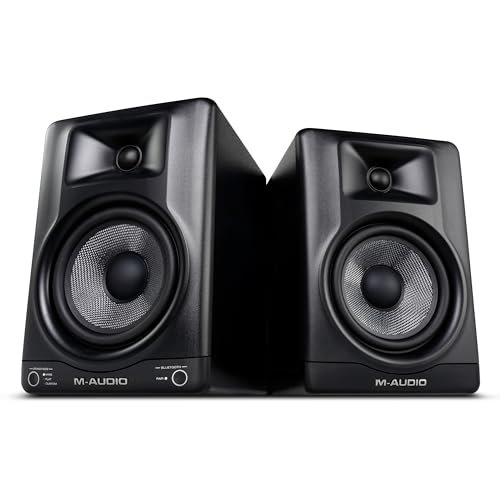
- DSP modes and five-band app EQ
- Bluetooth 5.0 wireless streaming
- Pair includes isolation pads
Best For: Desktop creators wanting DSP customization and Bluetooth
Immersive-Mixing Pick

- Coaxial driver for precise imaging
- 140W biamplified output
- Room-tuning and mounting flexibility
Best For: Stereo and Dolby Atmos studio environments
Reliable Room-Tuning Starter

- 73-watt self-powered 7-inch monitor pair
- Bi-amped Class A/B amplification
- Front port and low/high adjustment controls
Best For: Home studios wanting durable monitors with simple room tailoring
True DSP Imaging Specialist

- 32-bit, 96 kHz DSP with FIR filters
- Coaxial 8-inch design for detailed imaging
- 180W RMS Class D amplification
Best For: Mixing and professional monitoring where DSP correction matters
Connected DSP Workhorse

- ADAU1701 DSP circuitry
- USB, XLR, TRS, and RCA inputs
- 500W peak bi-amplified Class D system
Best For: Desktop producers needing DSP and flexible computer connectivity
Powerful Room-Filling Choice – PreSonus Eris Studio 8
The PreSonus Eris Studio 8 is a strong option for shoppers seeking studio monitors with built in dsp-style room-adjustment controls. Its 8-inch woven-composite woofer, 1.25-inch silk-dome tweeter, and 140W Class AB biamplification are designed for extended bass, clear highs, and high output during music production and other audio work.
Best For: Larger rooms, bass-focused production, and users who need flexible acoustic tuning.
Pros:
- 8-inch woofer reaches down to 35 Hz for extended low-end response.
- EBM waveguide provides a broad 120° by 60° listening area and stereo imaging.
- HF, midrange, highpass, and Acoustic Space controls help compensate for room placement.
- Balanced XLR, TRS, and unbalanced RCA inputs support varied setups.
Cons:
- The larger cabinet may be excessive for compact desks or small rooms.
- It is a wired monitor without wireless communication.
Choose the Eris Studio 8 when output, low-end reach, and placement flexibility matter more than keeping the monitor footprint small.
Most Flexible Acoustic Tuning – KRK Rokit 8 Generation Five
The KRK RP8G5 is a practical pick among studio monitors with built in dsp-style tuning features, offering 25 boundary and EQ combinations to help address acoustic problems. Its 8-inch woven Kevlar woofer, low-diffraction baffle, and isolation pads support accurate low-mid performance and improved setup stability.
Best For: Producers who want extensive room correction options for professional recording, mixing, and monitoring.
Pros:
- 25 boundary and tuning EQ combinations provide substantial placement flexibility.
- Woven Kevlar woofer targets tight, accurate low and low-mid performance.
- Low-diffraction baffle is designed to reduce distortion and improve stereo imaging.
- Included foam wedge isolation pads help minimize resonance.
Cons:
- Its 8-inch design and 12.6-inch depth require meaningful desk or stand space.
- The supplied notes list analog XLR and TRS connectivity but no wireless communication.
The RP8G5 stands out when room correction and setup control are priorities, especially in a dedicated production environment.
Compact Balanced Performer – PreSonus Eris Studio 5
PreSonus Eris Studio 5 5.25-inch 2-Way Active Studio Monitors with EBM Waveguide
Check Price On AmazonThe PreSonus Eris Studio 5 offers a smaller-format route into studio monitors with built in dsp-style acoustic controls. Its 5.25-inch woven-composite woofer, 1-inch silk-dome tweeter, and 80W biamplification provide a balanced choice for desktop production, while the EBM waveguide helps maintain a broad sweet spot.
Best For: Desktop studios, smaller rooms, and creators seeking room-position adjustments without an oversized monitor.
Pros:
- Compact 5.25-inch design delivers a 48 Hz to 20 kHz frequency response.
- EBM waveguide supports a wide listening area and stereo imaging.
- HF, midrange, highpass, and Acoustic Space controls aid placement adjustment.
- XLR, TRS, and RCA inputs accommodate balanced and unbalanced sources.
Cons:
- Its smaller woofer cannot provide the same low-end reach as an 8-inch monitor.
- It is a corded monitor rather than a wireless speaker.
The Eris Studio 5 is a sensible middle ground for nearfield listening when desk space and controlled room placement are important.
Small-Space Monitoring Pick – Yamaha HS3 Powered Studio Monitor Pair
The Yamaha HS3 is a compact powered pair for shoppers who want straightforward studio monitoring in a small workspace. While it does not list built-in DSP, it includes room control and high-trim response controls, plus XLR/TRS combo, RCA, and stereo mini inputs for connecting common production devices.
Best For: Compact desks, entry-level studio setups, and nearfield monitoring where space is limited.
Pros:
- Small 3.5-inch woofer and 0.75-inch tweeter suit space-constrained setups.
- Room Control and High Trim controls allow basic response adjustment.
- Multiple inputs include XLR/TRS combo, RCA, and stereo mini connections.
- Package includes speaker cable, stereo mini-to-RCA cable, and anti-slip pads.
Cons:
- The 70 Hz to 22 kHz response offers less low-end extension than the larger monitors here.
- Output is rated at 26W and above 26W, so it is intended for smaller nearfield use rather than high-volume rooms.
- It lacks the more extensive tuning combinations described for the KRK model.
The HS3 is best viewed as a convenient, compact monitoring solution rather than a full-range option for bass-heavy production.
Wide-Sweet-Spot Choice – PreSonus Eris E7 XT
PreSonus Eris E7 XT 2-Way Active Studio Monitor with EBM Waveguide (Pack of 1)
Check Price On AmazonThe PreSonus Eris E7 XT is a practical option for shoppers seeking studio monitors with built in dsp-style room adjustment. Its acoustic tuning controls let you tailor the monitor’s level, high-pass filter, low- and high-frequency trim, and acoustic-space response to your setup.
Best For: Home studios and mixing setups that need a wide sweet spot, solid imaging, and flexible acoustic adjustments.
Pros:
- 6.55-inch woven-composite woofer delivers extended low-end response.
- EBM waveguide provides a wide 100° horizontal by 60° vertical sweet spot.
- Includes acoustic tuning controls for adapting the monitor to your room.
- Includes Studio One Prime and the Studio Magic plug-in suite.
Cons:
- Sold as a single monitor rather than a pair.
- Its 6.5-inch format needs more desk or stand space than compact monitors.
- The supplied notes describe acoustic tuning, but not app-based DSP control.
The Eris E7 XT emphasizes broad, consistent monitoring and physical room-tuning controls. It is a strong fit when placement flexibility and included production software matter more than wireless streaming or app control.
Best App-Controlled Pair – M-Audio BX5BT
The M-Audio BX5BT is a compact pair for buyers looking for studio monitors with built in dsp. Its DSP crossover, selectable reference modes, five-band EQ, and app-based presets make it easy to adapt the sound for different rooms or listening preferences.
Best For: Modern creators who want compact desktop monitors with DSP tuning, Bluetooth streaming, and flexible app control.
Pros:
- Built-in DSP offers FLAT, HYPE, and CUSTOM reference modes.
- Studio Control App provides five-band EQ and saved custom presets.
- Bluetooth 5.0 supports wireless playback with a stated 100-foot range.
- Sold as a pair with isolation pads and a speaker interconnect cable.
Cons:
- The 5-inch woofer provides less driver area than the 6.5-inch options here.
- Bluetooth and HYPE modes may be less appropriate for strictly neutral mixing.
- Rear-panel connectivity is limited to TRS inputs alongside Bluetooth.
The BX5BT is the most directly DSP-focused choice in this group, combining room-oriented voicing with convenient wireless playback. Choose it when desktop size, app customization, and a complete stereo pair are priorities.
Immersive-Mixing Pick – PreSonus Eris Pro 6
The PreSonus Eris Pro 6 suits buyers seeking studio monitors with built in dsp-style acoustic correction for demanding stereo or surround work. Its coaxial driver design, room-tuning controls, and flexible balanced and unbalanced inputs support accurate placement and imaging.
Best For: Professional stereo mixing and immersive Dolby Atmos rooms that need consistent dispersion and extended low end.
Pros:
- Coaxial design improves phase alignment, imaging, and symmetrical dispersion.
- 140W Class AB biamplification reaches up to 106 dB SPL at one meter.
- Acoustic controls include HF, midrange, low-cut, and acoustic-space settings.
- Offers XLR, TRS, and RCA inputs plus wall and ceiling mounting options.
Cons:
- Sold as a single monitor.
- Larger and more powerful than necessary for a small desktop setup.
- The supplied notes describe onboard tuning controls rather than app-based DSP.
The Eris Pro 6 is the most specialized option for controlled stereo imaging and immersive monitoring. Its coaxial architecture and mounting flexibility make it particularly compelling for surround or Dolby Atmos installations.
Reliable Room-Tuning Starter – KRK Classic 7
The KRK Classic 7 is a practical choice for buyers seeking studio monitors with built in dsp-style room adjustment controls, although its supplied features specify dedicated low- and high-frequency level adjustments rather than onboard DSP. This self-powered pair uses matched amplification, a bi-amped Class A/B design, and front-firing ports for flexible tabletop placement.
Best For: Home studios and producers who want a durable 7-inch monitor pair with straightforward acoustic adjustment controls.
Pros:
- 73-watt active monitor with matched amps and bi-amped Class A/B amplification.
- Dedicated low- and high-frequency controls help tailor response to the room.
- Front-firing ports allow more flexible placement near walls.
- Heavy-duty enclosure and included three-year warranty support long-term use.
Cons:
- Does not list built-in DSP processing in the supplied specifications.
- Offers fewer connectivity and processing features than the other monitors here.
The Classic 7 keeps setup simple: connect the pair, position them on a desk or stands, and use the level controls to compensate for the room. It is a sensible option when dependable amplification and physical placement flexibility matter more than advanced digital correction.
True DSP Imaging Specialist – PreSonus Sceptre S8
The PreSonus Sceptre S8 is the strongest match here for shoppers specifically seeking studio monitors with built in dsp. Its coaxial design combines an 8-inch midrange driver and 1-inch horn-loaded tweeter, while 32-bit, 96 kHz dual-core DSP applies Temporal Equalization through multiple FIR filters.
Best For: Professional monitoring, mixing, and listeners who prioritize precise imaging and digital time correction.
Pros:
- Built-in 32-bit, 96 kHz DSP provides Temporal Equalization with FIR filters.
- Coaxial transducer supports a symmetrical soundstage and detailed imaging.
- 180W RMS Class D amplification and 116 dB maximum continuous SPL offer substantial output.
- Flexible acoustic controls include HF adjustment, Acoustic Space settings, and a selectable high-pass filter.
Cons:
- Its 8-inch design and 24.3-pound weight may require more room and sturdier placement.
- Supplied details list one monitor rather than a pair.
- The stated warranty is one year.
Among these options, the Sceptre S8 delivers the most clearly documented DSP-based feature set. The coaxial driver and extensive acoustic controls make it especially appealing when imaging accuracy and adaptable low-frequency management are central to the buying decision.
Connected DSP Workhorse – Rockville APM8D
The Rockville APM8D combines an 8-inch woofer, bi-amplified Class D power, and ADAU1701 DSP circuitry with unusually broad connectivity. For buyers comparing studio monitors with built in dsp, it adds USB audio alongside XLR, 1/4-inch TRS, and RCA inputs, making direct computer playback possible without an external interface.
Best For: Producers, content creators, DJs, and desktop users who want DSP, USB connectivity, and adjustable bass and treble in one monitor system.
Pros:
- ADAU1701 DSP circuitry supports precise frequency response and low distortion.
- USB, XLR, 1/4-inch TRS, and RCA inputs accommodate computers and studio equipment.
- Bi-amplified Class D design delivers 500W peak power according to the supplied notes.
- MDF enclosure, front panel construction, and rear bass port are designed to support controlled low-end performance.
Cons:
- Rear-firing bass ports may require more care with wall placement.
- The supplied specifications describe a 500W peak rating, not continuous output.
- Its 8-inch cabinets and 40-pound listed weight make it less compact for small desks.
The APM8D stands out as a versatile desktop and studio solution rather than a purely traditional monitor. Its DSP circuitry, direct USB connection, multiple analog inputs, and tone controls make it convenient for mixed computer, production, and DJ setups.
How We Picked the Best Studio Monitors with Built in Dsp
We evaluated these studio monitors by focusing on the factors that matter most in real recording, mixing, and production setups: frequency balance, driver size, amplifier design, nearfield suitability, room-control options, connectivity, construction, and overall value. We also considered whether each model makes sense for a compact desk, a dedicated studio, or a larger listening space.
Although the roundup includes several monitor types and price points, not every model offers the same DSP feature set. Check the individual specifications carefully if onboard digital room correction is essential to your setup; some monitors rely on analog rear-panel controls rather than built-in DSP.
Quick Comparison
| Best For | What to Prioritize | Recommended Direction |
|---|---|---|
| Small desk or bedroom studio | Compact cabinet, controlled bass, low listening fatigue | 5-inch or compact 3-inch-class monitors |
| General nearfield mixing | Balanced response and useful room controls | 5- to 7-inch monitors |
| Large room or bass-heavy production | Higher output and deeper low end | 8-inch monitors |
| Detailed stereo imaging | Coaxial or carefully designed waveguide | Coaxial or wide-dispersion designs |
| Simple desktop playback | Convenient inputs and easy setup | Models with Bluetooth or flexible consumer connections |
Key Buying Factors for Studio Monitors with Built-In DSP
DSP and Room Correction
Built-in DSP can help compensate for placement and room-response problems, but it cannot fully fix poor speaker positioning or severe acoustic issues. Look for models with adjustable filters, measurement-based calibration, presets, or app control if you need repeatable correction.
Driver Size and Room Volume
Smaller monitors are usually easier to place on a desk and can be more forgiving in a compact room. Larger 7- and 8-inch designs provide more headroom and bass extension, but they need greater listening distance and careful positioning to avoid overwhelming a small room.
Inputs, Controls, and Noise
Professional balanced inputs help reduce interference over longer cable runs. Check whether the monitor offers XLR, TRS, RCA, or digital connections, and consider front-panel volume control or headphone convenience if the speakers will serve as everyday desktop audio.
Placement and Acoustic Treatment
Place the monitors symmetrically at ear height, form an equilateral triangle with your listening position, and keep them away from corners where possible. Isolation pads, stands, and basic acoustic treatment can improve accuracy as much as upgrading speakers.
Who Should Buy Which Studio Monitors with Built in Dsp?
Choose a compact 5-inch monitor if you work close to the speakers, have limited desk space, or mix in a small untreated room. Move to a 6- or 7-inch model when you want more low-end authority without the footprint and room demands of a large monitor.
An 8-inch pair is a better fit for larger rooms, louder monitoring, and bass-focused production, provided you can position the speakers properly. Coaxial designs are worth considering when precise imaging and a coherent point-source presentation are priorities. For casual production, gaming, or a hybrid desktop system, convenient connectivity may matter more than advanced calibration.
Before buying, confirm whether the model truly includes DSP or only analog EQ controls, check the required listening distance, and budget for stands or isolation. The best monitor is the one that suits your room and lets you make reliable decisions—not simply the one with the largest woofer or highest power rating.