A cinemascope setup can make movies feel dramatically more immersive, but the screen matters as much as the projector. The right surface, aspect ratio, size, and installation style help preserve image quality across wide-format films.
We’ve compared 10 projector screens for cinemascope, from premium fixed-frame models to portable and motorized designs, so you can match your theater, room, and viewing habits with less guesswork.
Best 10 Projector Screens for Cinemascope Picks for 2026
Premium Fixed-Frame Pick
AWOL VISION 120-Inch Fixed-Frame Screen

- 4K/8K and active 3D ready
- 170-degree viewing angle
- Compatible with standard, short-throw, and ultra-short-throw projectors
Best For: Dedicated home theaters needing a permanent, high-resolution screen
Best Motorized Upgrade
Elite Screens 125-Inch Electric Drop-Down Screen

- Motorized 125-inch 16:9 design
- IR and RF remotes included
- 4K/8K-ready material with 180-degree viewing
Best For: Retractable home theater installations using standard projectors
Best Portable Option
PropVue 100-Inch Tripod Projector Screen
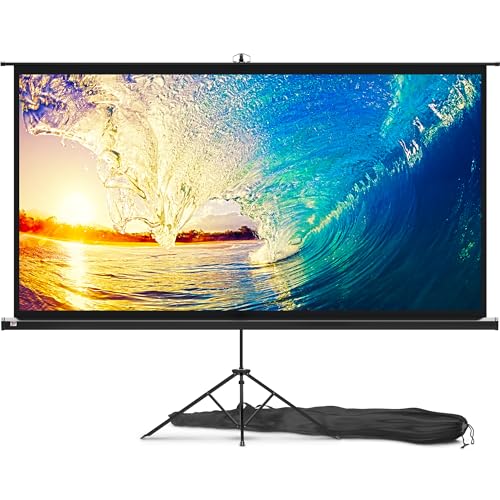
- Three-step portable setup
- Adjustable tripod height
- Indoor and outdoor use with carrying bag
Best For: Movie nights, presentations, and events in changing locations
Largest Screen Value
SiliBamb 200-Inch Motorized Projector Screen

- Massive 200-inch diagonal image
- Remote-controlled electric operation
- Wall- or ceiling-mountable metal casing
Best For: Large rooms and group movie or presentation viewing
Laser-Ready Cinema Pick
Valerion 100-Inch PureVision Fixed Frame

- PET matte surface helps reduce laser speckle
- Supports up to 8K resolution
- 170° viewing angle with 1.0 gain
Best For: Dedicated home theaters with laser projectors
Retractable Theater Value
Kayle 120-Inch Motorized Screen

- Electric retractable design with RF remote
- 1.2 gain and 4K/active 3D readiness
- Wall or ceiling mounting options
Best For: Multipurpose rooms and convenient home theaters
Portable Outdoor Cinema Pick
ZUVMITG 120-Inch Screen with Stand

- Includes stand, carry bag, stakes, ropes, and sandbags
- Supports front and rear projection
- Portable 120-inch 4K HD display
Best For: Backyard movies, camping, and temporary screenings
Premium Motorized Pick
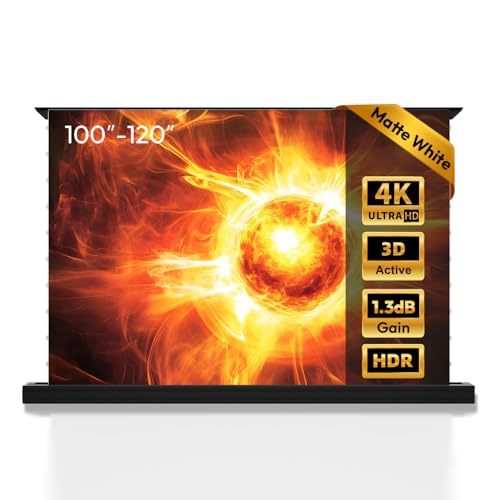
- 1.3-gain matte-white PVC surface
- USB projector sync and quiet motor
- 170° viewing angle with black backing
Best For: Dedicated home theaters wanting automatic operation
Portable Large-Format Pick
120-Inch Foldable Movie Screen

- 120-inch 16:9 viewing area
- Folds for backpack or suitcase storage
- Front and rear projection support
Best For: Portable indoor, outdoor, and presentation use
Premium Fixed-Frame Pick – AWOL VISION 120-Inch Fixed-Frame Screen
For dedicated theater rooms seeking projector screens for cinemascope-style viewing, the AWOL VISION MW-120 emphasizes image clarity, broad seating coverage, and a clean fixed-frame installation. Its matte white PVC surface supports 4K, 8K, and active 3D projection.
Best For: Dedicated home theaters using standard, short-throw, or ultra-short-throw projectors.
Pros:
- 4K/8K and active 3D projection ready.
- 170-degree viewing angle helps accommodate wider seating arrangements.
- Tensioning rod system supports quick assembly, while the surface cleans with mild soap and water.
- Black-backed design helps improve contrast and reduce light reflection.
Cons:
- Fixed-frame wall mounting is less portable than a tripod screen.
- At 120 inches, it requires a suitably sized wall and viewing room.
The AWOL VISION is the most theater-focused option here, especially if you want a permanent screen that works across projector types and supports high-resolution content.
Best Motorized Upgrade – Elite Screens 125-Inch Electric Drop-Down Screen
The Elite Screens ELECTRIC125H2 is a convenient choice among projector screens for cinemascope setups that need a large image without leaving a screen permanently visible. Its motorized 16:9 surface drops from a wall- or ceiling-mounted black case and is controlled by included IR and RF remotes.
Best For: Home theaters using standard UHD or HD projectors and requiring retractable installation.
Pros:
- 125-inch diagonal viewing area with a 1.1-gain MaxWhite 2 surface.
- 4K Ultra HD and active 3D projection ready.
- 180-degree viewing angle and fully black-backed material.
- Includes IR/RF remotes, programmable drop position, and a wired 12-volt trigger option.
Cons:
- Not compatible with short-throw or ultra-short-throw projectors.
- Motorized hardware requires wall or ceiling installation and electrical setup.
This model stands out when retractability and remote operation matter more than short-throw compatibility. Its ready-to-install design also simplifies setup compared with assembling a fixed frame.
Best Portable Option – PropVue 100-Inch Tripod Projector Screen
For flexible movie nights, presentations, and outdoor events, the PropVue 100-inch screen offers the portability fixed installations lack. Its 16:9 matte surface, adjustable height, tripod support, tight straps, and carrying bag make it a practical option among projector screens for cinemascope-style content in changing locations.
Best For: Indoor and outdoor movie nights, classrooms, offices, churches, and backyard viewing.
Pros:
- Portable tripod design assembles in three steps.
- Adjustable height supports different viewing environments.
- 1.1-gain matte surface and 160-degree viewing angle provide broad visibility.
- Includes a fitted carrying bag for transport.
Cons:
- Its 100-inch size is smaller than the fixed and motorized alternatives.
- A tripod stand is less visually streamlined than a permanent wall-mounted screen.
- The notes do not specify 4K or 8K readiness.
The PropVue is the sensible pick when easy relocation matters most. It trades premium theater permanence for quick setup and the ability to move between indoor and outdoor venues.
Largest Screen Value – SiliBamb 200-Inch Motorized Projector Screen
The SiliBamb 200-inch electric screen is designed for viewers who want a very large 16:9 image for home theaters, offices, classrooms, or outdoor screenings. Its PVC matte white surface uses a 1.1 gain and can be raised or lowered with an integrated switch or radio-frequency remote.
Best For: Large rooms and venues that can accommodate a 200-inch screen for movies, presentations, or group viewing.
Pros:
- Very large 200-inch diagonal size with a 174.02-by-98.03-inch view area.
- Motorized operation supports remote or integrated-switch control.
- 160-degree viewing angle and 1.1-gain matte white PVC material.
- Dual-purpose metal casing supports wall or ceiling installation.
Cons:
- The 200-inch format requires substantial wall or ceiling space.
- Its 16:9 ratio may not fill a cinemascope-format image without unused screen area.
- The notes do not specify 4K, 8K, or active 3D readiness.
The SiliBamb prioritizes scale and convenience. Choose it when the room can support a 200-inch installation and a large shared image is more important than a cinema-specific aspect ratio.
Laser-Ready Cinema Pick – Valerion 100-Inch PureVision Fixed Frame
For projector screens for cinemascope-style home theaters, the AWOL Valerion PureVision is a strong fixed-frame option when image consistency and laser-projector compatibility matter. Its PET matte surface, 1.0 gain, and tensioned construction are designed to preserve brightness, color, and fine detail.
Best For: Dedicated home theaters using long-throw or UST laser projectors.
Pros:
- PET matte material is engineered to reduce laser speckle and support natural color reproduction.
- Supports resolutions up to 8K with a precision-tensioned frame.
- 170° viewing angle helps maintain consistent brightness and color from wide seating positions.
- Fixed aluminum frame with a slim 10 mm bezel provides a clean theater-style appearance.
Cons:
- Fixed-frame wall or ceiling mounting is less flexible than a retractable screen.
- The 100-inch size may not suit viewers seeking a larger cinema display.
Choose this screen if you want a permanent, flat projection surface tailored to premium laser projectors. Its neutral 1.0-gain finish prioritizes balanced image reproduction over added brightness.
Retractable Theater Value – Kayle 120-Inch Motorized Screen
The Kayle 120-inch motorized screen is a practical choice among projector screens for cinemascope setups that need a screen to disappear when not in use. Its electric retractable design, 16:9 format, and included controls suit home theaters, presentations, and multipurpose rooms.
Best For: Multipurpose rooms needing a large, remotely operated indoor screen.
Pros:
- Motorized retractable operation includes an RF remote and detachable three-way wall switch.
- 1.2-gain, black-backed screen supports 4K Ultra HD and active 3D projection.
- 180° listed viewing angle in the product highlights supports broad seating coverage.
- Includes wall or ceiling mounting hardware and arrives assembled for plug-and-play installation.
Cons:
- The 16:9 aspect ratio is not a native cinemascope-wide format.
- Electric operation requires access to a suitable power connection.
- The product information lists both 180° and 160° viewing-angle figures.
This screen is best when convenient storage and a generous 120-inch image matter more than a fixed cinemascope frame. Its retractable housing makes it easier to share a room with other activities.
Portable Outdoor Cinema Pick – ZUVMITG 120-Inch Screen with Stand
For projector screens for cinemascope-style movie nights beyond a fixed theater room, this 120-inch ZUVMITG model emphasizes portability and outdoor stability. The stand, carry bag, windproof accessories, and front/rear projection support make it suited to backyards, camping, and temporary indoor setups.
Best For: Outdoor movie nights, camping, tailgating, and portable indoor screenings.
Pros:
- Includes a reinforced base, steel frame, stakes, ropes, and two sandbags for outdoor stability.
- Washable milk silk fabric is designed for vibrant 4K HD visuals and wrinkle reduction.
- Supports front and rear projection with a 160° viewing angle.
- Folds flat and includes a dedicated storage bag for transport.
Cons:
- Floor-mounted stand requires setup space and is less permanent than a fixed frame.
- Windproof accessories need to be used outdoors when conditions require additional stability.
- The listed glossy finish may reflect more ambient light than a matte surface.
This is the most flexible option for screenings that move between locations. It trades permanent-theater convenience for a complete portable setup with weather-oriented securing accessories.
Premium Motorized Pick – 100-Inch Floor-Rising Screen
For a dedicated home theater using projector screens for cinemascope, this motorized floor-rising model offers a polished, low-effort setup. Its 100-inch matte-white PVC surface has 1.3 gain, black backing, and a wide 170-degree viewing angle for bright, consistent images.
Best For: Dark-room home theaters that prioritize automatic operation and compatibility with standard, short-throw, or UST projectors.
Pros:
- Motorized rising and retracting operation with USB projector sync.
- 1.3 gain matte-white PVC surface supports 4K/8K UHD and Active 3D content.
- Black backing helps block light penetration, while the 170-degree viewing angle suits multiple seats.
- Quiet DC motor includes soft start and stop, position memory, and overheat protection.
Cons:
- Floor-mount design requires dedicated space in front of or below the viewing area.
- The 100-inch screen is smaller than some portable 120-inch alternatives.
- Its electric mechanism is less convenient to relocate than a folding screen.
This is the most theater-oriented option in the group, especially if you want a clean installation and one-touch control. It is less suitable for frequent travel, but its retractable design and broad projector compatibility make it a strong fixed-room choice.
Portable Large-Format Pick – 120-Inch Foldable Movie Screen
This 120-inch foldable screen is a practical choice for projector screens for cinemascope when portability and a large viewing area matter most. Its 16:9 polyester surface folds into a compact size, supports front or rear projection, and can be mounted with hooks, ropes, brackets, nails, or tape.
Best For: Budget-conscious users who need a lightweight screen for indoor movies, presentations, or occasional outdoor viewing.
Pros:
- Large 120-inch diagonal with a stated 104-by-58-inch viewing area.
- Lightweight 1.7-pound foldable design is easy to store in a backpack or suitcase.
- Supports both front and rear projection with a 160-degree viewing angle.
- Washable polyester material is designed to resist creasing and simplify maintenance.
Cons:
- It is a manual wall-mount screen without a built-in frame or stand.
- Requires separate hooks, ropes, brackets, nails, or adhesive for installation.
- The 16:9 format may not fill a cinemascope image without unused space or cropping.
Choose this model when easy transport and maximum size are more important than motorized convenience. Its flexible mounting and double-sided projection support make it versatile, though you will need to provide a suitable way to tension or hang it.
Outdoor Theater Pick – 100-Inch Tripod Projection Screen
For flexible projector screens for cinemascope setups, this 100-inch tripod model balances portability with outdoor stability. The wrinkle-resistant polyester screen supports front and rear projection, while the included carry bag, sandbag, ground stakes, and ropes help adapt the setup for backyard or indoor use.
Best For: Backyard movie nights, camping, and users who need a freestanding screen that can move between indoor and outdoor locations.
Pros:
- Tool-free detachable crossbar and quick-opening tripod simplify assembly.
- Thick, foldable, washable screen supports front and rear projection.
- Included carry bag makes the 7.5-pound setup easier to transport.
- Sandbag, wind ropes, and ground stakes provide added outdoor stabilization.
Cons:
- Outdoor setup requires careful anchoring, especially in windy conditions.
- Manual tripod design takes more setup time than a motorized screen.
- At 100 inches, it offers less image area than the 120-inch foldable option.
This is the most adaptable pick for viewers who regularly change locations. Its included stability accessories are useful outdoors, but the screen should be properly tensioned and anchored for a flat, reliable display.
How We Picked These Projector Screens for Cinemascope
We focused on screen designs that can support a cinematic widescreen experience while remaining practical for home theaters, multipurpose rooms, presentations, and outdoor movie nights. Our comparison considers screen size, stated aspect ratio, surface material, gain, installation method, portability, included accessories, and compatibility with 4K or 8K projection.
Because cinemascope content is wider than standard 16:9 material, we also considered how easily each screen can fit into a dedicated setup. A 16:9 screen can still work well, but it may leave unused space or require careful image positioning with an ultra-wide projector.
Quick Comparison
| Screen type | Best suited for | Main advantage | Potential trade-off |
|---|---|---|---|
| Fixed frame | Dedicated theaters | Flat, stable viewing surface | Requires permanent wall space |
| Motorized drop-down | Multipurpose rooms | Retracts when not in use | Needs power and secure mounting |
| Floor-rising | Flexible indoor setups | Minimal wall installation | Requires clear floor space |
| Portable stand or foldable | Outdoor and temporary viewing | Easy to move and store | More sensitive to wind and wrinkles |
Key Buying Factors for Projector Screens for Cinemascope
Aspect Ratio and Image Placement
Check your projector’s native aspect ratio and the format of the movies you watch most. A 16:9 screen is versatile for streaming, gaming, and television, while a wider screen may better suit cinemascope content. Make sure the screen’s visible area is large enough for the intended image without forcing excessive cropping or unused borders.
Screen Size and Viewing Distance
Larger is not always better. Measure the wall or room width, seating distance, projector throw distance, and ceiling height before buying. The image should fill the screen comfortably without requiring viewers to turn their heads or sit too close to the front row.
Surface, Gain, and Viewing Angle
Matte white surfaces generally provide broad viewing angles and natural-looking color. Higher gain can produce a brighter image but may narrow the viewing angle or emphasize hotspots. For cinemascope systems, prioritize an even surface and uniform brightness, especially when multiple people watch from different seats.
Installation and Portability
Fixed-frame screens are usually the best choice for a dedicated theater. Motorized and floor-rising models suit rooms that serve more than one purpose. Stand-mounted and foldable screens are better for temporary installations, but check frame stability, crease resistance, carrying options, and outdoor anchoring hardware.
Projector Compatibility
Look for a screen rated for your projector’s brightness and resolution. A screen labeled 4K or 8K ready does not create higher resolution by itself; it indicates that the material and construction are intended to display a detailed image. Laser projectors may also benefit from surfaces designed to reduce speckle or preserve color accuracy.
Who Should Buy Which Projector Screens for Cinemascope?
Choose a fixed-frame screen if you are building a permanent cinema and want the flattest, most consistent surface. Choose a motorized or floor-rising model if you need to hide the screen between viewing sessions. For backyard films, travel, or occasional presentations, a portable stand screen or foldable model offers the simplest setup. If your room is wide, your seating is spread out, or your projector produces a very bright image, prioritize a matte surface with a generous viewing angle and moderate gain.