Portable video distribution amplifiers make it easier to send one video source to multiple displays, monitors, recorders, or security-system endpoints without relying on improvised splitters.
This roundup covers compact SDI, HDMI, composite, and BNC-based options, from simple two-output units to higher-capacity distribution amplifiers for production, monitoring, gaming, and CCTV use.
Best 10 Portable Video Distribution Amplifiers Picks for 2026
Professional SDI Signal Hub

- SD, HD, and 3G-SDI support
- Eight re-clocked outputs
- Embedded audio and redundant input
Best For: Broadcast and live-event SDI distribution
Compact Analog Monitoring Splitter
AuviPal 4-Port BNC Distributor
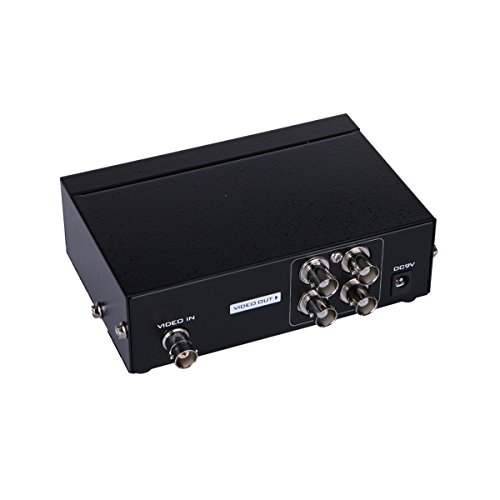
- One BNC input and four outputs
- Supports PAL, NTSC, and SECAM
- Metal housing with plug-and-play setup
Best For: Analog CVBS surveillance and monitoring
Buffered HD-SDI Repeater
AJA HD5DA Distribution Amplifier

- Four buffered HD-SDI/SDI outputs
- Automatic input equalization
- Automatic multi-standard operation
Best For: Compact professional SDI repeating
Powered RCA A/V Duplicator
DTECH 4-Way Composite Splitter

- One RCA input to four outputs
- Amplifies composite video and stereo audio
- Includes 9V adapter and color-coded ports
Best For: Composite gaming, monitoring, and dubbing setups
Best Audio Utility
ST-DA3 Portable Distribution Amplifier

- Drives up to three balanced or unbalanced loads
- Wideband, low-noise audio circuitry
- Compact 2 x 4 x 2-inch freestanding design
Best For: Portable AV systems needing flexible three-output audio distribution
Best RCA Multidistributor
MT-VIKI 8-Way Composite A/V Splitter

- Duplicates one RCA A/V source to eight outputs
- Active signal booster for longer connections
- Metal housing with included 9V adapter
Best For: Legacy composite-video and stereo RCA distribution
Best 8K HDMI Option
1x2 HDMI 2.1b Distribution Amplifier
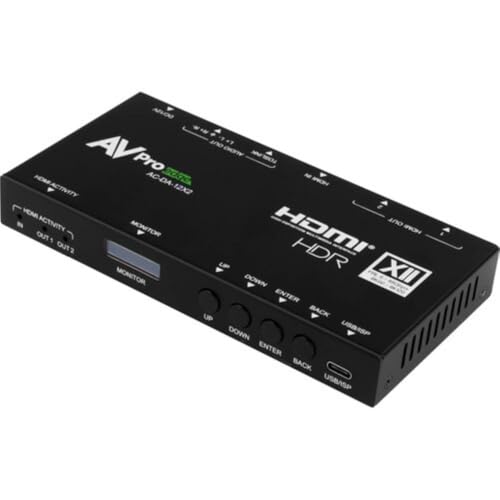
- Splits one HDMI source to two outputs
- Supports up to 8K60 and 48 Gb/s bandwidth
- Includes EDID and HDCP support
Best For: High-resolution HDMI systems with two display destinations
Best Long-Distance SDI Pick
Compact 1×4 SDI Distribution Amplifier

- Auto-detects HD-, SD-, and 3G-SDI signals
- Reclocks all four outputs
- Supports long-distance SDI transmission
Best For: Long-distance SDI video distribution
Best High-Output HDMI Pick
1:16 HDMI Distribution Amplifier

- Distributes to 16 channels
- Switches video and audio
- Includes rack ears
Best For: Rack-mounted HDMI systems with many displays
Best Simple BNC Pick
Speco 1×4 BNC Video Distribution Amplifier

- Provides one input and four outputs
- Uses BNC connectors
- Compact and lightweight enclosure
Best For: Basic four-way BNC video distribution
Professional SDI Signal Hub – Blackmagic Mini Converter
For broadcast, live-event, and other professional setups, the Blackmagic Design Mini Converter is a versatile choice among portable video distribution amplifiers. It accepts SD, HD, and 3G-SDI signals and provides eight re-clocked outputs for distributing one source across multiple devices.
Best For: Broadcast and live-event systems that need flexible SDI distribution with embedded audio and ancillary-data support.
Pros:
- Supports switchable SD, HD, and 3G-SDI input formats.
- Provides eight re-clocked SDI outputs.
- Supports ASI, ancillary data, and embedded audio.
- Includes automatic format switching and a redundant SDI input.
Cons:
- Designed for SDI workflows rather than analog composite or RCA systems.
- Requires a 12-volt minimum power supply.
With broad format support and eight outputs in a portable mini-converter design, this model is a strong fit when signal flexibility and reliable distribution matter more than basic home-video simplicity.
Compact Analog Monitoring Splitter – AuviPal 4-Port BNC Distributor
The AuviPal 4-Port BNC splitter is a straightforward option among portable video distribution amplifiers for analog monitoring systems. It takes one BNC video input and sends the signal to four BNC-compatible displays or devices, with support for resolutions up to 1080p at 60Hz.
Best For: CCTV, surveillance, studio, and other analog CVBS installations needing four simultaneous video outputs.
Pros:
- Splits one BNC input to four outputs.
- Supports PAL, NTSC, and SECAM analog formats.
- Plug-and-play design requires no additional configuration.
- Durable metal housing is suited to continuous operation.
Cons:
- Not compatible with SDI or digital signals.
- Requires cameras to be set to CVBS mode.
This is a practical choice for analog video distribution where simple installation and four BNC outputs are the priority, but digital and SDI users should choose a different type of amplifier.
Buffered HD-SDI Repeater – AJA HD5DA Distribution Amplifier
The AJA HD5DA is a compact professional option among portable video distribution amplifiers, designed for HD-SDI and SDI signal paths. Its single input feeds four separately buffered outputs, while automatic equalization helps it function as a low-cost repeater.
Best For: HD-SDI or SDI installations needing four buffered outputs and automatic multi-standard operation.
Pros:
- Provides four separately buffered serial HD-SDI/SDI outputs.
- Includes automatic input equalization.
- Supports automatic multi-standard operation.
- Compact design is suitable for surface mounting.
Cons:
- Offers four outputs, fewer than some larger distribution amplifiers.
- Focused on SDI formats rather than analog video or RCA audio/video.
For professional SDI systems that need a compact four-output repeater, the HD5DA emphasizes buffered distribution and automatic signal handling without adding unnecessary complexity.
Powered RCA A/V Duplicator – DTECH 4-Way Composite Splitter
The DTECH 4-Way RCA splitter is a practical analog option among portable video distribution amplifiers for duplicating composite video and stereo audio. Its powered design sends one three-RCA source to four outputs, making it useful for multiple TVs, monitors, speakers, or capture devices.
Best For: Gaming consoles, home A/V systems, dubbing projects, and multi-monitor setups using composite RCA connections.
Pros:
- Splits one composite video and stereo-audio source to four outputs.
- Built-in amplification supports clearer video and audio over longer connections.
- Durable metal housing includes anti-skid feet and heat dissipation.
- Includes a 9V AC power adapter, LED indicator, and color-coded jacks.
Cons:
- Designed for analog RCA connections rather than SDI or digital signals.
- Requires external AC power for active signal duplication.
- Does not include switching between multiple sources.
This compact powered splitter suits users who need to duplicate a single composite A/V source across four destinations, especially when standard RCA connectivity is more important than modern digital formats.
Best Audio Utility – ST-DA3 Portable Distribution Amplifier
The RDL ST-DA3 is a compact choice for portable video distribution amplifiers setups that also need flexible audio handling. It can bridge an audio line, adjust gain, and drive up to three balanced or unbalanced, high- or low-impedance loads.
Best For: Installers and AV users who need portable, three-output audio distribution alongside a video system.
Pros:
- Drives up to three audio loads.
- Supports balanced or unbalanced connections.
- Wideband circuitry is designed for low distortion and low noise.
- Compact freestanding 2 x 4 x 2-inch form factor.
Cons:
- It is an audio distribution amplifier rather than a video signal splitter.
- Requires 24 VDC power.
- No warranty is listed in the supplied details.
The ST-DA3 is best viewed as an audio companion for a portable video distribution setup. Its flexible load support and small enclosure make it useful when clean, distributed audio is the priority.
Best RCA Multidistributor – MT-VIKI 8-Way Composite A/V Splitter
The MT-VIKI MT-108AV is a practical analog option among portable video distribution amplifiers, duplicating one composite RCA audio/video source to eight matching outputs. Its powered design helps distribute the signal over longer connections without requiring software.
Best For: DVR, monitor, and legacy composite-video installations that need one source mirrored to eight displays or destinations.
Pros:
- Provides one RCA A/V input and eight RCA A/V outputs.
- Built-in active signal booster supports longer-distance connections.
- Metal housing and anti-skid feet aid installation stability and heat dissipation.
- Includes a 9V DC power adapter.
Cons:
- Supports composite RCA connections rather than HDMI.
- Mirrors one source to eight outputs; it is not an 8-to-1 switcher.
- Designed for stereo analog audio and composite video.
Choose the MT-108AV when your system is built around RCA composite equipment and needs broad one-to-many duplication. It is less suitable for newer digital HDMI workflows.
Best 8K HDMI Option – 1×2 HDMI 2.1b Distribution Amplifier
This HDMI 2.1b unit is a forward-looking choice for portable video distribution amplifiers, sending one HDMI source to two displays. It supports resolutions up to 8K60, 48 Gb/s video bandwidth, multichannel digital audio, and EDID management for modern AV installations.
Best For: Modern HDMI systems that need two synchronized output destinations and high-bandwidth video support.
Pros:
- Distributes one HDMI input to two HDMI outputs.
- Supports resolutions up to 8K60.
- Offers 48 Gb/s video bandwidth and multichannel digital audio support.
- Includes EDID and HDCP support plus mounting brackets.
Cons:
- Provides only two outputs.
- Requires a 12V DC power supply.
- Its high-bandwidth capabilities may exceed basic display needs.
For a compact two-display HDMI installation, this model offers substantially more bandwidth than legacy analog splitters. Its EDID management and included mounting hardware are useful when integrating current high-resolution sources and displays.
Best Long-Distance SDI Pick – Compact 1×4 SDI Distribution Amplifier
For portable video distribution amplifiers handling SDI signals, the AVMATRIX SD1141 offers one input and four outputs in a compact enclosure. It supports auto-detection for HD-, SD-, and 3G-SDI signals up to 1080p 60Hz, making it a practical choice for production and installation setups.
Best For: Long-distance SDI distribution where reclocking and flexible mounting are useful.
Pros:
- Supports HD-, SD-, and 3G-SDI signals up to 1080p 60Hz.
- Provides transmission distances up to 400m for SD, 200m for HD, and 120m for 3G-SDI signals.
- Reclocks all outputs and includes a detachable wall-mounting bracket.
- Includes a three-year warranty and lifetime technical support.
Cons:
- Uses SDI connectors rather than HDMI.
- Only outputs 2 and 4 support DVB-ASI signals.
The SD1141 is the strongest fit here when your system is SDI-based and cable distance matters. Its four-output layout and signal reclocking add practical value for distributed video installations.
Best High-Output HDMI Pick – 1:16 HDMI Distribution Amplifier
Among portable video distribution amplifiers, this 1:16 HDMI model is designed for systems that need to send video and audio from a source to many displays. Its rack-mount design and included rack ears make it better suited to organized equipment installations than highly mobile setups.
Best For: HDMI systems requiring distribution to up to 16 channels in a rack-mounted configuration.
Pros:
- Provides 16 distribution channels.
- Handles both video and audio switching.
- Includes rack ears for installation.
- Designed for trouble-free computer connections.
Cons:
- Its 8-pound weight and rack-mount format are less convenient for lightweight portability.
- The supplied notes do not specify supported resolutions or transmission distances.
This model stands out when output count is the priority. Choose it for a rack-based HDMI deployment with many destinations, but verify resolution and distance requirements before purchase.
Best Simple BNC Pick – Speco 1×4 BNC Video Distribution Amplifier
Speco VIDDIST 1 in/4 Out Video Distribution Amplifier 1 Input to 4 Output Video Bnc Splitter
Check Price On AmazonFor a straightforward analog-style setup, the Speco VIDDIST is a compact video distribution amplifier with one input and four BNC outputs. Its small plastic housing makes it a practical option when you need basic four-way BNC video splitting without a larger rack-style unit.
Best For: Simple BNC video distribution in compact installations.
Pros:
- Offers one input and four outputs.
- Uses BNC connectors for compatible video equipment.
- Compact dimensions of approximately 4.5 × 3.5 × 1 inch.
- Lightweight 13.4-ounce design.
Cons:
- The supplied notes do not specify supported resolutions or transmission distances.
- Uses a plastic enclosure.
- Provides fewer outputs than the 1:16 HDMI model.
The VIDDIST is a sensible choice for uncomplicated BNC installations where a small footprint and four-way distribution are enough. Confirm compatibility with your source and display equipment before ordering.
How We Picked These Portable Video Distribution Amplifiers
We selected models across the main video formats and output ranges represented in this category. Our comparison considers signal compatibility, number and type of outputs, portability, power requirements, connector layout, and suitability for common applications such as field production, video monitoring, home entertainment, gaming, and security cameras.
Because a distribution amplifier is only useful when it matches the source and displays, format support takes priority over output count alone. A compact HDMI unit may be the best choice for a modern display chain, while an SDI model is more appropriate for cameras and professional video equipment.
Quick Comparison
| Best For | Look For | Typical Output Type |
|---|---|---|
| Professional cameras and broadcast gear | SDI, HD-SDI, or 3G-SDI support | BNC |
| Televisions, projectors, and streaming systems | HDMI version and resolution support | HDMI |
| Older AV equipment and gaming systems | Composite video and audio compatibility | RCA |
| CCTV and monitoring installations | 75-ohm BNC connections and stable signal regeneration | BNC |
| Large display networks | Eight or more independently buffered outputs | HDMI, RCA, or BNC |
Key Buying Factors for Portable Video Distribution Amplifiers
Signal Format and Resolution
Match the amplifier to the source, cable, and display chain. SDI, HDMI, and composite video are not interchangeable without conversion hardware. For HDMI, verify the supported resolution, refresh rate, HDR features, and HDMI generation. For SDI, check whether the unit supports SD, HD, or 3G-SDI as required.
Output Count and Signal Reliability
Choose enough outputs for current needs while allowing modest expansion. A one-to-two unit suits a camera and confidence monitor, whereas a one-to-eight or one-to-16 amplifier is more practical for classrooms, showrooms, control rooms, or multi-display installations. Buffered and reclocked outputs can help preserve signal quality across longer cable runs.
Connections and Installation
Confirm connector type, cable direction, and whether the product distributes video only or video and audio. BNC models generally suit SDI and CCTV cabling, RCA models suit composite systems, and HDMI models fit consumer and computer-based equipment. Also check whether the device is desktop-friendly, rack-mountable, or genuinely convenient for field use.
Power and Portability
Portable equipment should be easy to position and power. Review the included adapter, voltage requirements, power-button design, and enclosure size. For mobile production or temporary monitoring, a compact unit with clearly labeled ports can be more useful than a higher-capacity model that is difficult to transport.
Who Should Buy Which Portable Video Distribution Amplifiers?
Choose an SDI distribution amplifier for professional cameras, switchers, and broadcast-style monitoring. HDMI models are the natural fit for televisions, projectors, computers, streaming devices, and modern presentation systems. Composite RCA amplifiers are best for legacy gaming, older AV equipment, and installations that already use analog video and stereo audio.
For CCTV or BNC monitoring, prioritize compatible impedance, connector quality, and the required number of outputs. Buyers building a larger display network should select the output capacity they need and confirm that every connected device supports the same video standard. If you only need to duplicate one source to two nearby screens, avoid paying for a large multi-output chassis when a compact portable model will do the job.