The best portable DACs with balanced output can turn a phone, tablet, or laptop into a more capable headphone source. They combine digital-to-analog conversion with amplification, while 4.4mm balanced connections can provide additional power and a more secure option for compatible headphones and IEMs.
This roundup covers compact USB dongles, feature-rich portable amplifiers, and high-output models with both 3.5mm and 4.4mm connections. The right choice depends on your headphones, device compatibility, power requirements, controls, and how portable your setup needs to be.
Best 10 Portable Dacs with Balanced Output Picks for 2026
Best High-Power Dongle

- Up to 550mW in Desktop mode
- 3.5mm and 4.4mm outputs
- PCM 384kHz/32-bit and DSD256
Best For: High-power portable listening in a compact dongle
Best Feature-Rich Portable DAC

- 4.4mm balanced output and 1000mW amplifier
- USB, optical, coaxial, Bluetooth, and analog inputs
- PCM 768kHz, DSD512, and MQA support
Best For: Flexible wired and wireless portable audio systems
Best Adjustable-Gain Dongle

- 3.5mm and 4.4mm outputs
- Three hardware gain levels
- Physical volume buttons and 18g weight
Best For: Mobile users who switch between IEMs and headphones
Best for DSP Customization

- App-based parametric EQ tuning
- Dual CS43198 DAC chips
- 3.5mm/4.4mm outputs with 100-level volume
Best For: Listeners who want hands-on sound customization
Flagship Hi-Res Pick
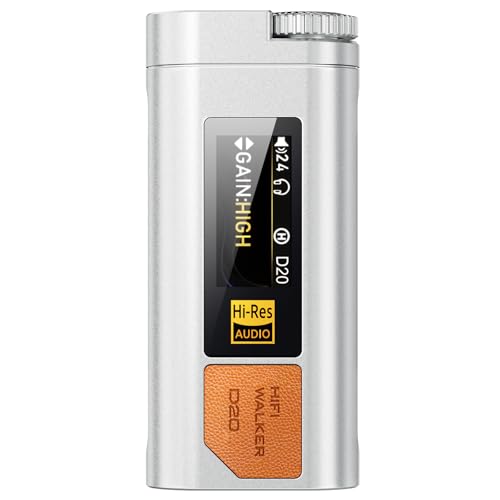
- PCM 768kHz/DSD512 support
- 4.4mm balanced output up to 280mW
- OLED display and aluminum build
Best For: High-resolution listening with powerful balanced output
Tube-Warm Powerhouse
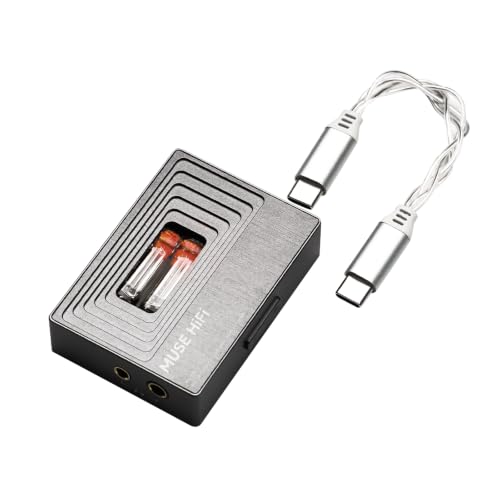
- JAN6418 vacuum tube sound
- 480mW 4.4mm balanced output
- PCM 384kHz/DSD256 support
Best For: Warm, powerful portable listening with IEMs or headphones
Compact Everyday Value
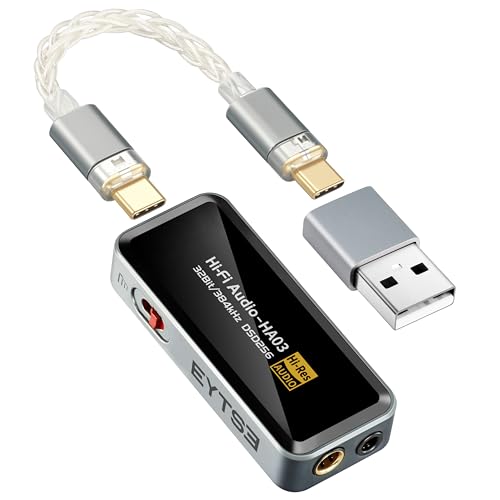
- Dual CS43131 decoding
- 4.4mm balanced and gain switch
- 18g body with physical controls
Best For: Portable everyday listening with flexible device compatibility
High-Power Travel Pick
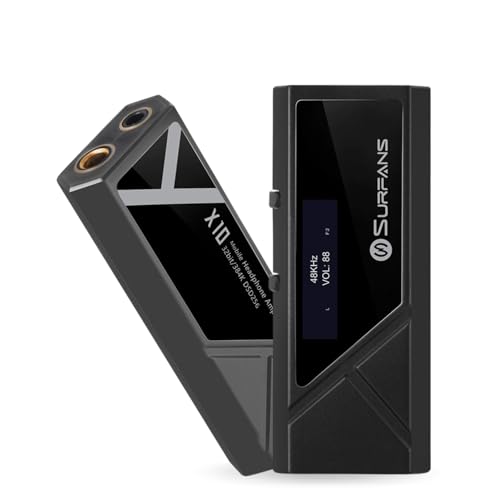
- 4.4mm balanced and 3.5mm outputs
- Up to 522mW of output power
- Compact USB-C aluminum design
Best For: Travel listeners needing strong output and flexible connections
Tuning-Focused Hi-Fi Pick

- 4.4mm balanced output with up to 220mW at 32 ohms
- Supports PCM 768kHz and native DSD512
- Adds hardware PEQ and spatial audio
Best For: Listeners wanting extensive sound customization and gaming support
Efficient Everyday Choice

- 3.5mm and 4.4mm balanced outputs
- Supports DSD256 and PCM 32-bit/384kHz
- 60-step physical volume control
Best For: Mobile users wanting simple high-resolution balanced listening
Best High-Power Dongle – FiiO/JadeAudio KA13
The FiiO/JadeAudio KA13 is a strong choice among portable dacs with balanced output when you want desktop-style drive in a compact USB-C dongle. Its 4.4mm balanced connection, 550mW Desktop mode, and dual-DAC design make it suitable for both IEMs and more demanding headphones.
Best For: Listeners who want high output power and a compact 3.5mm/4.4mm setup for phones, computers, or music players.
Pros:
- Desktop mode provides up to 550mW through the balanced output.
- Offers both 3.5mm single-ended and 4.4mm balanced outputs.
- Supports PCM up to 384kHz/32-bit and DSD256.
- FIIO Control app supports settings such as RGB lighting, filters, and SPDIF output.
Cons:
- Desktop mode may require more power from the connected device.
- Its small dongle format provides less display and control space than larger DAC/amps.
The KA13 stands out for packing unusually high balanced-output power into a small aluminum dongle. It is especially appealing if your priority is driving a broad range of headphones without moving to a larger portable amplifier.
Best Feature-Rich Portable DAC – iFi xDSD Gryphon
The iFi xDSD Gryphon is a versatile pick among portable dacs with balanced output, combining a 4.4mm balanced connection with USB, optical, coaxial, Bluetooth, and analog connectivity. It also adds a 1000mW amplifier, screen, gain management, and selectable sound features for a flexible travel or desktop setup.
Best For: Users who need broad source compatibility, high-resolution decoding, wireless playback, and a powerful balanced headphone amplifier.
Pros:
- Supports 4.4mm balanced and 3.5mm S-Balanced inputs and outputs.
- Offers USB PCM up to 32-bit/768kHz, native DSD512, and full MQA decoding.
- Bluetooth 5.1 supports formats including aptX HD, aptX Adaptive, LDAC, and HWA/LHDC.
- Includes iEMatch, auto-gain, XBass, xSpace, and a 1000mW amplifier.
Cons:
- At 215g, it is less pocket-friendly than a small USB dongle.
- A TOSLINK mini-plug to TOSLINK adapter is not included.
- Its large feature set may be more than needed for simple wired listening.
The xDSD Gryphon is the most connectivity-focused option here. Choose it when you want one portable unit to handle wired digital sources, Bluetooth, and balanced headphones rather than a minimalist dongle.
Best Adjustable-Gain Dongle – TempoTec Sonata BHD
The TempoTec Sonata BHD offers a practical balance of portability and control for anyone comparing portable dacs with balanced output. Alongside 3.5mm and 4.4mm connections, it provides three hardware gain levels and physical volume buttons, making it easier to adapt output for sensitive IEMs or larger headphones.
Best For: Portable listeners who want tactile volume control, adjustable gain, and broad Android, iOS, Mac, and Windows compatibility.
Pros:
- Includes both 3.5mm single-ended and 4.4mm balanced outputs.
- Three-position hardware gain control suits different headphone sensitivities.
- Physical volume buttons allow independent, smoother adjustment.
- Supports native DSD256 and PCM up to 32-bit/384kHz.
Cons:
- The supplied notes do not specify a maximum output power rating.
- Windows compatibility is listed for Windows 10 version 1703 and later.
At 18g, the Sonata BHD is a particularly portable option for commuters and mobile setups. Its gain switch and onboard controls are more useful than headline specifications if you regularly switch between IEMs and headphones.
Best for DSP Customization – MOONDROP Dawn PRO 2
The MOONDROP Dawn PRO 2 is a compelling choice among portable dacs with balanced output for listeners who want to shape their sound. It combines dual CS43198 DAC chips with 3.5mm and 4.4mm outputs, 100-level volume control, and app-based parametric EQ adjustments.
Best For: Audiophiles who want detailed DSP tuning, smooth independent volume control, and a compact balanced DAC/amp for most headphones.
Pros:
- MOONDROP app enables detailed EQ adjustments for frequency, gain, Q value, and filter type.
- Uses dual CS43198 DAC chips and three independent LDO power chips.
- Provides 3.5mm and 4.4mm outputs with up to 124 + 124mW output.
- Supports 100-level DAC volume control and PCM 384kHz/32-bit with DSD256.
Cons:
- Its 124 + 124mW output is lower than the KA13 and xDSD Gryphon ratings.
- Advanced app-based DSP may be unnecessary for listeners who prefer plug-and-play operation.
- The supplied notes do not list broad device compatibility details.
The Dawn PRO 2 is the tuning-oriented option in this group. Its balanced output is paired with unusually detailed app customization, making it a good fit for listeners who want to tailor headphone response rather than simply add amplification.
Flagship Hi-Res Pick – HIFI WALKER D20 DAC512
The HIFI WALKER D20 DAC512 is a strong choice for listeners comparing portable dacs with balanced output and wanting extensive format support. Its 4.4mm balanced connection delivers up to 280mW, while the 3.5mm output offers a convenient single-ended alternative. The OLED display, physical controls, and aluminum construction also make it practical for mobile or desktop use.
Best For: Audiophiles and portable listeners who want high-resolution playback, a display, and substantial balanced-output power.
Pros:
- Supports PCM up to 768kHz/32-bit and native DSD512.
- Provides both 4.4mm balanced and 3.5mm outputs.
- Includes an OLED display, ALPS volume knob, and CNC-machined aluminum body.
- Works with Android, Windows, Mac, laptops, and tablets without requiring a driver.
Cons:
- Its feature set may be more than casual listeners need.
- The supplied notes do not specify battery operation, so it is designed around USB-C power.
Choose the D20 when maximum file support, visible controls, and a powerful balanced connection matter more than the smallest possible dongle form factor.
Tube-Warm Powerhouse – MUSEHiFi M3 Ultra
The MUSEHiFi M3 Ultra stands out among portable dacs with balanced output by pairing a JAN6418 vacuum tube with a 4.4mm connection rated at 480mW. It also includes a 3.5mm output rated at 460mW, giving it plenty of stated power for both sensitive IEMs and more demanding headphones. Its compact USB-C design supports phones, computers, and tablets.
Best For: Listeners who want tube-influenced warmth, high output power, and support for both IEMs and headphones.
Pros:
- Uses a JAN6418 vacuum tube for a warmer, smoother presentation.
- Offers 460mW through 3.5mm and 480mW through 4.4mm balanced.
- Supports PCM up to 32-bit/384kHz and DSD256.
- Includes a triple noise-reduction approach to address tube microphonics.
Cons:
- Tube-based operation may not suit listeners seeking a strictly neutral presentation.
- The supplied notes do not mention a display or physical playback controls.
The M3 Ultra is the most distinctive option here for buyers who prioritize tube character without giving up strong balanced-output power or modern high-resolution support.
Compact Everyday Value – EYTSE HA03 Mini DAC Amp
For shoppers seeking portable dacs with balanced output in a lightweight dongle, the EYTSE HA03 combines dual CS43131 decoding with 3.5mm and 4.4mm connections. Its physical gain switch helps accommodate sensitive IEMs or more power-hungry planar earphones, while playback and volume buttons add convenience for daily phone use.
Best For: Commuters and mobile listeners who want a small, driver-free DAC with flexible outputs and gain control.
Pros:
- Dual CS43131 decoders support up to 32-bit/384kHz and DSD256.
- Includes both 4.4mm balanced and 3.5mm single-ended outputs.
- Physical gain, playback, and volume controls improve everyday usability.
- 18g aluminum-and-glass body is compact and designed for heat dissipation.
Cons:
- The supplied notes do not state a balanced-output wattage.
- Its USB-C dongle format depends on the connected device for power.
The HA03 is a practical pick when portability and hands-on controls are more important than a built-in screen or the highest published output rating.
High-Power Travel Pick – Surfans X10
For listeners comparing portable dacs with balanced output, the Surfans X10 stands out with a 4.4mm balanced connection, a 3.5mm output, and up to 522mW of power. Its USB-C design works with compatible phones, tablets, computers, and music players, making it a flexible wired-audio upgrade for travel or everyday listening.
Best For: Users who want substantial output power and broad device compatibility in a compact aluminum DAC/amp.
Pros:
- Offers both 3.5mm single-ended and 4.4mm balanced outputs.
- Provides up to 522mW of output power for additional headroom with compatible headphones and IEMs.
- Uses ES9028Q2M and ES9603 chips with Hi-Res audio support.
- Compact aluminum body and physical controls suit commuting and travel.
Cons:
- Requires compatible USB-C source devices and headphones or IEMs for balanced operation.
- Its wired design does not provide wireless connectivity.
The X10 is a strong choice when power and port flexibility matter most. It is particularly appealing for listeners who want a portable balanced output without giving up a standard 3.5mm connection.
Tuning-Focused Hi-Fi Pick – Fosi Audio DS3
The Fosi Audio DS3 is one of the more feature-rich portable dacs with balanced output, pairing a 4.4mm balanced port with a 3.5mm output, high-resolution decoding, and built-in customization. Its battery-free USB-C format is designed for phones, PCs, PS5, and Switch, while the included spatial processing and PEQ add flexibility beyond basic amplification.
Best For: Critical listeners and gamers who want high-resolution playback, hardware EQ, and spatial audio features from a lightweight dongle.
Pros:
- Supports up to 32-bit/768kHz PCM and native DSD512.
- Delivers up to 220mW at 32 ohms through the balanced output.
- Includes 8 digital filters and a 32-band hardware-level PEQ.
- Lightweight 16g aluminum construction and driver-free platform support.
Cons:
- Does not include a built-in microphone.
- Its extensive EQ and spatial features may be unnecessary for users seeking a simple dongle.
Choose the DS3 if adjustment options are as important as clean amplification. Its balanced output, advanced decoding, and platform versatility make it a compelling option for both music-focused and gaming setups.
Efficient Everyday Choice – Fosi Audio DS2
For a straightforward option among portable dacs with balanced output, the Fosi Audio DS2 combines 3.5mm and 4.4mm connections with dual CS43131 DAC chips. It supports high-resolution playback up to PCM 32-bit/384kHz and DSD256, while its physical volume buttons and broad USB-C compatibility make it practical for daily phone, tablet, and computer use.
Best For: Mobile listeners seeking a compact, easy-to-use balanced DAC/amp with independent volume controls.
Pros:
- Provides both 3.5mm single-ended and 4.4mm balanced outputs.
- Supports PCM 32-bit/384kHz and DSD256 playback.
- Offers up to 170mW per channel at 32 ohms.
- Includes independent 60-step volume controls and volume memory.
Cons:
- Its maximum output is lower than the Surfans X10 listed here.
- Requires a USB-C source and compatible balanced headphones or IEMs to use the 4.4mm connection.
The DS2 focuses on useful everyday features rather than elaborate processing. Its dual outputs, low-noise design, physical controls, and wide compatibility make it a sensible portable companion for high-resolution mobile listening.
How We Picked These Portable Dacs with Balanced Output
We focused on portable DAC/amp models that offer a balanced headphone connection, with preference for products that also include a standard 3.5mm output. The selection spans affordable USB-C dongles, higher-powered battery-equipped units, and specialized designs with features such as adjustable gain, physical volume controls, display or app support, and broad operating-system compatibility.
We also considered published output power, supported formats, connector flexibility, portability, and practical use with phones, tablets, computers, IEMs, and full-size headphones. High-resolution format support can be useful, but it was not treated as a substitute for sensible power delivery, low noise, or convenient everyday operation.
Quick Comparison
| What to Compare | Best For | Why It Matters |
|---|---|---|
| Small USB dongle | Phone and laptop listening | Lightweight, simple, and usually affordable |
| Battery-powered DAC/amp | Demanding headphones | More output without drawing as much power from the source device |
| 4.4mm balanced output | Compatible headphones and IEMs | Often offers higher available power and a robust connector |
| 3.5mm plus 4.4mm | Mixed headphone collections | Supports both conventional and balanced cables |
| Physical buttons or gain control | Frequent mobile use | Makes volume and power adjustments faster and safer |
Key Buying Factors for Portable Dacs with Balanced Output
Output Power and Headphone Sensitivity
Balanced output is not automatically better for every headphone. Its main practical advantage is often increased power, but the benefit depends on headphone impedance, sensitivity, cable wiring, and listening volume. Efficient IEMs generally need little power, while demanding over-ear models may benefit from a stronger DAC/amp or a battery-powered design.
Connections and Device Support
Check whether the unit uses USB-C, Lightning compatibility, or an included adapter for your source. Confirm that your headphones have a correctly wired 4.4mm balanced cable before using that output. A balanced jack should never be connected to a device or cable designed for shared-ground single-ended operation unless the manufacturer explicitly supports it.
Noise, Controls, and Battery Use
Very sensitive IEMs can reveal hiss from powerful amplifiers, so low-noise performance matters as much as maximum wattage. Physical volume buttons, gain settings, mute behavior, and independent volume control can improve daily usability. Battery-powered units add weight but may provide better performance with difficult headphones and reduce phone battery drain.
Audio Formats and Software
PCM, DSD, and high sample-rate specifications are useful for compatibility, but most listeners should prioritize stable drivers, reliable device support, and a clean analog stage. iOS users should verify adapter and power requirements, while Windows users may need to check whether a model is plug-and-play or requires a driver.
Who Should Buy Which Portable Dacs with Balanced Output?
Choose a small USB-C dongle if you want the lightest upgrade for a phone, tablet, or laptop and primarily use efficient headphones or IEMs. Choose a model with both 3.5mm and 4.4mm outputs if you own mixed cables or want room to expand your collection.
Consider a higher-output or battery-powered unit if you use full-size headphones, listen away from a desk, or need more consistent drive than a basic dongle can provide. Buyers who prioritize precise volume adjustment should look for hardware buttons and gain control, while listeners with sensitive IEMs should favor low-noise performance over headline power figures.