The best desktop AV receivers bring multiple sources, immersive audio, and modern video connectivity into one control center. The right model can simplify a compact stereo setup or power a full surround-sound theater.
Our selection covers affordable stereo receivers, compact 5.2-channel options, and feature-rich 7.2-channel models with 4K, 8K, Dolby Atmos, streaming, and wireless connectivity.
Best 10 Desktop Av Receivers Picks for 2026
Best Overall
Denon AVR-X1700H 7.2-Channel AV Receiver

- 7.2-channel audio with Dolby Atmos and DTS:X
- Three 8K HDMI inputs and eARC
- Wi-Fi, HEOS, AirPlay 2, and voice control
Best For: Feature-rich home theater and multi-room streaming
Best Stereo Value
Sony STRDH190 2-Channel Receiver

- 100 watts per channel at 8 ohms
- Dedicated phono input and Bluetooth
- A/B speaker switching for flexible setups
Best For: Stereo music and turntable-based systems
Best for 8K Gaming
Denon AVR-S570BT 5.2-Channel Receiver

- Four HDMI 2.1 inputs with 8K support
- VRR and QFT for responsive gaming
- 5.2-channel surround with eARC
Best For: Gaming-focused 8K home entertainment systems
Best Budget Flexibility
Donner MAMP8 5.2-Channel AV Receiver

- 5.2-channel support with two active subwoofers
- HDMI ARC, Bluetooth 5.3, USB, and phono
- Adjustable treble, midrange, and bass
Best For: Flexible multi-source systems on a budget
Best Smart-Streaming Pick

- Dolby Atmos and DTS:X with 5.2.2 support
- 4K/120 and 8K/60 HDMI video support
- Wi-Fi, Bluetooth Multipoint, and room correction
Best For: Easy streaming and flexible home theater setup
Best Compact-Room Value

- 80 watts per channel across seven channels
- Three 8K inputs and 4K/120 pass-through
- HEOS multi-room streaming with Wi-Fi and Bluetooth
Best For: Small- to medium-room theaters with wireless streaming
Best Connectivity and THX Pick

- THX Certified Select amplification system
- Eight HDMI ports with three 40Gbps HDMI 2.1 inputs
- Dolby Atmos/DTS:X and Zone 2 audio-video support
Best For: Feature-heavy systems needing many connections
Versatile Network Pick
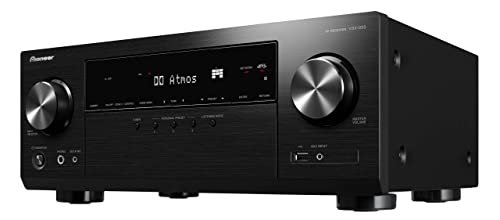
- 7.2-channel surround configuration
- Dolby Atmos and DTS:X support
- Eight HDMI ports plus Wi-Fi and Bluetooth
Best For: Multi-device home theater systems needing flexible connectivity
Gaming-Focused Value

- 4K/120Hz HDR pass-through
- VRR, ALLM, and QFT gaming features
- eARC with immersive audio support
Best For: Console gaming setups with compatible 4K displays
Easy-Setup Atmos Choice

- Dolby Atmos and DTS Virtual:X
- 4K/120 and 8K/60 HDMI support
- Automatic room correction with setup microphone
Best For: Compact systems prioritizing simple calibration and modern video
Best Overall – Denon AVR-X1700H 7.2-Channel AV Receiver
For shoppers comparing desktop AV receivers for a capable home theater, the Denon AVR-X1700H combines 7.2-channel amplification, Dolby Atmos and DTS:X support, and advanced 8K HDMI connectivity. Its guided setup and broad streaming options make it a practical choice for movie nights, gaming, and multi-room listening.
Best For: Home theater users who want immersive audio, 8K-ready video, streaming, and room for a more advanced speaker setup.
Pros:
- Supports Dolby Atmos, DTS:X, DTS Virtual:X, and Dolby Atmos Height Virtualization.
- Includes three dedicated 8K HDMI inputs, 4K/120Hz pass-through, and eARC.
- Offers Wi-Fi, Bluetooth, AirPlay 2, HEOS, voice control, and multi-room streaming.
- Color-coded connections and an on-screen setup guide simplify installation.
Cons:
- Its extensive features may be more than needed for a basic stereo system.
- The 80-watt-per-channel output may not suit users seeking maximum power for very large rooms.
The AVR-X1700H is the most complete option in this group for building a flexible, modern surround system. It is especially compelling if you need 8K video support, network streaming, and multiple ways to control the receiver.
Best Stereo Value – Sony STRDH190 2-Channel Receiver
The Sony STRDH190 is a straightforward choice among desktop AV receivers for listeners focused on two-channel music rather than surround sound. It pairs 100 watts per channel with a phono input, Bluetooth, multiple analog inputs, and flexible A/B speaker switching.
Best For: Stereo music systems, turntable owners, and listeners who want simple Bluetooth playback.
Pros:
- Delivers 100 watts per channel at 8 ohms for a strong stereo setup.
- Includes a dedicated phono input for connecting a turntable.
- Supports Bluetooth, four stereo RCA inputs, a 3.5mm input, and a headphone jack.
- A/B speaker switching can connect up to four speakers or separate zones.
Cons:
- It is a two-channel stereo receiver, not a surround-sound AV receiver.
- It does not provide HDMI connectivity or modern home theater video processing.
If your priority is music and vinyl rather than cinematic surround, the STRDH190 keeps the system simple while offering useful connectivity and ample stereo power. Its low-profile design also fits more easily into many conventional cabinets.
Best for 8K Gaming – Denon AVR-S570BT 5.2-Channel Receiver
The Denon AVR-S570BT is a practical pick for desktop AV receivers when 8K video, gaming features, and uncomplicated surround sound are the priorities. Its four HDMI 2.1 inputs support 8K, while VRR and QFT are designed to help provide responsive gameplay.
Best For: Gamers and movie viewers who want 5.2-channel surround sound with multiple 8K HDMI sources.
Pros:
- Provides four HDMI 2.1 inputs with 8K support and an eARC-equipped output.
- Supports VRR and QFT for gaming-focused video performance.
- Handles Dolby TrueHD, DTS-HD Master Audio, Dolby Vision, HDR10+, HDR10, and HLG.
- Includes Bluetooth streaming, app control, and an on-screen setup assistant.
Cons:
- Its 5.2-channel design offers less expansion than a 7.2-channel receiver.
- Wireless connectivity is centered on Bluetooth rather than built-in Wi-Fi.
The AVR-S570BT makes sense for a compact or mid-sized entertainment system with several current-generation gaming or streaming devices. It delivers the key 8K and HDR features without moving into a more complex 7-channel setup.
Best Budget Flexibility – Donner MAMP8 5.2-Channel AV Receiver
The Donner MAMP8 stands out among desktop AV receivers for its wide selection of inputs and hands-on sound controls. It supports 5.2-channel speaker connections, 4K HDR pass-through, Bluetooth 5.3, USB, phono, optical, coaxial, and FM sources in one compact receiver.
Best For: Budget-conscious users who need many wired and wireless inputs, including turntable and USB connectivity.
Pros:
- Supports five speakers and two active subwoofers in a 5.2-channel configuration.
- Offers HDMI ARC, Bluetooth 5.3, USB, RCA, optical, coaxial, phono, and FM inputs.
- Provides 4K HDR pass-through for compatible TV, movie, and gaming setups.
- Independent treble, midrange, and bass controls can be adjusted from the receiver or remote.
Cons:
- Dolby and DTS decoding are not supported.
- With two HDMI ports, it offers less HDMI connectivity than the Denon models.
- Its listed 75-watt output varies by speaker channel and impedance.
The MAMP8 is best viewed as a versatile audio amplifier with basic home theater pass-through rather than a full-featured cinematic AV platform. It is a useful fit when input variety and manual EQ control matter more than Dolby or DTS decoding.
Best Smart-Streaming Pick – Yamaha RX500A
For shoppers comparing desktop av receivers, the Yamaha RX500A combines 7.2-channel surround sound with Dolby Atmos, flexible 5.2.2 speaker layouts, and convenient wireless streaming. Its HDMI section supports 4K/120 and 8K/60 video, making it a versatile choice for home theater and gaming setups.
Best For: Buyers who want easy streaming, automatic room correction, and current-generation video support in one receiver.
Pros:
- Supports Dolby Atmos and DTS:X, including 5.2.2 speaker configurations.
- Offers 4K/120, 8K/60, Dolby Vision, HDR10+, ALLM, and VRR support.
- Includes Wi-Fi, Bluetooth Multipoint, Spotify Connect, Google Cast, AirPlay 2, TIDAL Connect, and Qobuz Connect.
- Included setup microphone automatically optimizes sound for the room.
Cons:
- Its 70-watt output is lower than some competing receivers.
- There are five HDMI ports, which may be limiting for especially device-heavy systems.
The RX500A is a well-rounded desktop av receiver for users who prioritize wireless music, immersive formats, and straightforward setup. It is particularly appealing when room correction and gaming-friendly HDMI features matter as much as surround sound.
Best Compact-Room Value – Denon AVR-X1800H
The Denon AVR-X1800H is a practical option among desktop av receivers for small- to medium-sized rooms. It provides 80 watts across seven channels, supports Dolby Atmos and DTS:X, and adds HEOS multi-room streaming alongside advanced 8K and 4K/120 video pass-through.
Best For: Small- to medium-room home theaters that need immersive audio, modern HDR support, and multi-room streaming.
Pros:
- Supports 7.2 or 5.2.2 Dolby Atmos/DTS:X configurations at 80 watts per channel.
- Includes three dedicated 8K inputs and one 8K output, with 4K/120 pass-through.
- Handles Dolby Vision, HLG, HDR10+, and Dynamic HDR pass-through.
- HEOS, Wi-Fi, AirPlay 2, Bluetooth, and multiple music services support wireless listening.
Cons:
- The supplied details list four HDMI ports, fewer than some alternatives.
- Its height virtualization features may not replace dedicated height speakers for every listener.
With a useful balance of power, video compatibility, and network features, the AVR-X1800H suits buyers building a streamlined system rather than an oversized installation. Its on-screen setup guide and color-coded connections also help simplify installation.
Best Connectivity and THX Pick – Onkyo TX-NR6100
The Onkyo TX-NR6100 stands out among desktop av receivers for its THX Select certification, extensive HDMI connectivity, and gaming-ready HDMI 2.1 inputs. It supports 7.2-channel sound, 5.2.2 Dolby Atmos or DTS:X playback, and separate Zone 2 audio and video.
Best For: Enthusiasts who need many HDMI connections, THX-certified performance, and multi-zone flexibility.
Pros:
- THX Certified Select with a 210-watt-per-channel dynamic audio amplification system.
- Supports 5.2.2 Dolby Atmos and DTS:X playback.
- Provides eight HDMI ports, including three HDMI 2.1 inputs with 40Gbps support and 8K capability.
- Offers discrete Zone 2 audio and video plus Wi-Fi, Bluetooth, and broad music-service support.
Cons:
- The supplied specifications list 100 watts of output alongside the 210-watt dynamic amplification figure, which may require careful comparison.
- Its larger chassis may be less convenient for especially compact desktop installations.
The TX-NR6100 is a strong fit when connection count and expansion options are priorities. Its THX certification and Zone 2 capability make it more appealing to dedicated home theater users than shoppers seeking only a basic receiver.
Versatile Network Pick – Pioneer VSX-935
The Pioneer VSX-935 is one of the more flexible desktop av receivers for listeners who want seven-channel surround sound, network connectivity, and broad source support. It offers Dolby Atmos and DTS:X decoding, eight HDMI ports, Wi-Fi, Bluetooth, USB, and voice control compatibility.
Best For: Home theater users who need many HDMI connections and immersive 7.2-channel audio.
Pros:
- Supports Dolby Atmos, DTS:X, and virtual height processing.
- Provides eight HDMI ports for multiple devices.
- Includes Wi-Fi, Bluetooth, USB, TuneIn, and voice-control support.
Cons:
- Its 170-watt specification applies to one driven channel under stated test conditions; two-channel FTC output is listed at 80 watts per channel.
- At 20.7 pounds, it is relatively substantial for a desktop setup.
The VSX-935 stands out when connectivity and speaker expansion matter most. It is a strong fit for a feature-rich 7.2-channel system, especially if you plan to connect several HDMI sources.
Gaming-Focused Value – Onkyo TX-NR5100
The Onkyo TX-NR5100 is a practical choice among desktop av receivers for gaming-oriented systems. Its HDMI 2.1 features include 4K/120Hz HDR pass-through, VRR, ALLM, and QFT, while eARC supports high-bitrate formats from compatible TV apps.
Best For: Gamers and TV-based systems seeking responsive 4K/120Hz video support with 7.2-channel sound.
Pros:
- Supports 4K/120Hz HDR pass-through for compatible gaming equipment.
- Includes VRR, ALLM, and QFT to address gaming lag and tearing.
- eARC supports Dolby Atmos, DTS:X, Dolby TrueHD, and DTS-HD Master Audio.
Cons:
- Provides four HDMI ports, fewer than some similarly configured receivers.
- Wireless connectivity is listed as Bluetooth; Wi-Fi is not specified in the supplied details.
The TX-NR5100 prioritizes gaming features and modern TV audio rather than an especially broad connection count. It makes the most sense for a console-centered setup with a compatible 4K display.
Easy-Setup Atmos Choice – Yamaha RX300A
The Yamaha RX300A is a compact 5.2-channel option for desktop av receivers, combining Dolby Atmos, DTS Virtual:X, 4K/120 and 8K/60 HDMI support, and automatic room correction. Bluetooth Multipoint also makes it convenient to switch between two paired source devices.
Best For: Smaller home theater systems that value straightforward setup, room calibration, and current video features.
Pros:
- Supports Dolby Atmos, DTS Virtual:X, 4K/120, and 8K/60 video.
- Included setup microphone enables automatic room optimization.
- Bluetooth Multipoint supports two paired source devices.
Cons:
- Its five-channel design is less expandable than the 7.2-channel alternatives.
- It has five HDMI ports.
The RX300A is appealing for users who want modern gaming and video support without a complicated setup. Its 5.2-channel layout can also support a 3.1.2-channel arrangement with height speakers.
How We Picked the Best Desktop Av Receivers
We compared these Desktop Av Receivers by looking at channel count, amplifier capability, HDMI support, surround-sound formats, networking, wireless playback, setup flexibility, and overall use case. We also included both traditional stereo receivers and multichannel AVRs because “desktop” systems vary from two-channel music stations to compact gaming and home theater setups.
Specifications can differ by region and connection type, so check the manufacturer’s current manual before buying—especially for HDMI features, speaker impedance, power ratings, and 8K or 4K/120 compatibility.
Quick Comparison
| Best For | Recommended Type | What to Prioritize |
|---|---|---|
| Music and vinyl | Two-channel stereo receiver | Phono input, Bluetooth, simple controls |
| Compact surround sound | 5.2-channel AVR | HDMI inputs, room correction, Dolby Atmos support |
| Full home theater | 7.2-channel network AVR | Power, speaker expansion, streaming, multiroom features |
| Gaming and new displays | Modern HDMI AVR | 4K/120, 8K pass-through, HDR support, low-latency features |
Key Buying Factors for Desktop Av Receivers
Channels and Speaker Layout
A 2-channel receiver is usually the simplest choice for bookshelf speakers, a turntable, or a desk-based music system. Choose a 5.2-channel model for a center speaker, surround speakers, and one or two subwoofers. A 7.2-channel receiver gives you more flexibility for larger rooms, additional surrounds, or Dolby Atmos configurations.
HDMI and Video Compatibility
Count your sources before buying, including game consoles, streaming devices, Blu-ray players, and computers. Look for enough HDMI inputs and outputs for your setup. If you use a current gaming console or high-refresh-rate display, verify support for 4K/120. Select 8K-capable models if you want greater long-term video headroom, but confirm which inputs support each feature.
Audio Formats and Room Correction
Dolby Atmos and DTS formats matter for immersive surround systems, while automatic room calibration can help compensate for speaker placement and room acoustics. For music-first systems, a quality phono stage, clean two-channel operation, and convenient source switching may matter more than additional surround formats.
Streaming and Connectivity
Wi-Fi, Bluetooth, network audio, AirPlay, and built-in streaming services can reduce the need for separate source devices. Bluetooth is convenient for casual playback; wired network or Wi-Fi features are generally better suited to regular high-quality streaming and multiroom use.
Who Should Buy Which Desktop Av Receivers?
Choose the Sony STR-DH190 if you primarily want affordable two-channel music playback with Bluetooth and a phono input. Choose a 5.2-channel model such as the Denon AVR-S570BT, Donner MAMP8, or Yamaha RX300A for a compact surround setup with fewer speaker demands. Choose a 7.2-channel model such as the Denon AVR-X1700H, Denon AVR-X1800H, Yamaha RX500A, Onkyo TX-NR6100, Pioneer VSX935, or Onkyo TX-NR5100 if you need more expansion room, network features, or a fuller theater system.
Before ordering, confirm cabinet ventilation, speaker placement, available power outlets, and the receiver’s physical depth. A model with more features is not automatically better if your desktop system only needs two speakers and a few sources.