The right screen can make a major difference when you use a projector in a room with windows, ceiling lights, or other sources of glare. Projector screens with ambient light rejection are designed to preserve contrast and image clarity by directing projected light toward viewers while minimizing unwanted light.
This roundup includes fixed-frame, motorized, portable, outdoor, standard-throw, and ultra-short-throw options. Use the buying guide below to match screen construction, gain, size, and projector compatibility to your space.
Best 10 Projector Screens with Ambient Light Rejection Picks for 2026
Bright-Room Cinema Pick
IN&VI 120-Inch Fresnel ALR Screen

- Claims 95% ambient light rejection
- 2.0 gain for brighter, higher-contrast images
- Fixed frame for standard and mid-long-throw projectors
Best For: Bright home theaters with standard or mid-long-throw projectors
DIY Builder’s Option
Yandood 130-Inch ALR Screen Fabric

- 69-by-118-inch gray DIY screen material
- 0.85 gain with black light-blocking backing
- For fixed-frame front projection only
Best For: Custom fixed-frame screen projects with suitable projectors
UST Bright-Room Match
NothingProjector 100-Inch ALR Screen

- Claims 85% ambient light rejection
- Purpose-built for ultra-short-throw projectors
- Fixed 10mm frame with 160° viewing angle
Best For: UST home theaters, classrooms, and offices
Best Edge-Free UST Pick
120-Inch SCREENPRO ALR Fixed Frame

- Up to 93% ambient light rejection
- 178° viewing angle and 0.85 gain
- 7 mm bezel for a TV-like look
Best For: Large UST or laser projector home theaters
Best Floor-Rising Option
IN&VI 100-Inch Motorized CLR ALR

- Claims 95% overhead light rejection
- Motorized, retractable floor-rising design
- No wall drilling; made for UST projectors
Best For: Renters and living rooms using laser TVs or UST projectors
Best Standard-Throw Choice
150-Inch Nano Silver ALR Screen

- Up to 70% ambient light rejection
- Designed for medium- and long-throw projectors
- Dual-tension, wrinkle-resistant fixed frame
Best For: Large spaces with higher-lumen standard-throw projectors
Best Portable Pick

- Claims over 90% ambient light rejection and 1.5 gain
- Tripod or wall mounting with two-minute setup
- Lightweight, height-adjustable design for indoor or outdoor use
Best For: Portable movie nights, camping, presentations, and flexible indoor setups
Best for Long-Throw Projectors
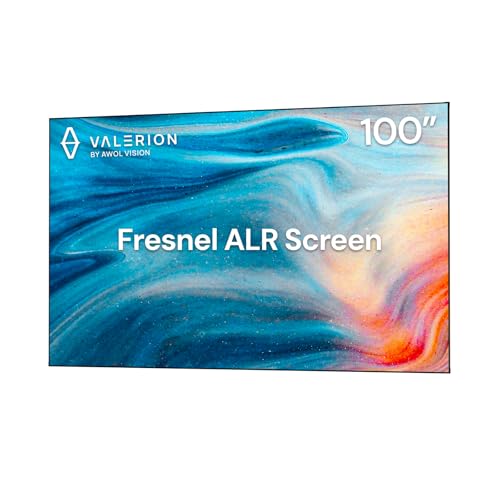
- Built specifically for compatible long-throw projectors
- 1.8 gain with up to 85% overhead and side light rejection
- Rollable, scratch-resistant surface supports 4K and 8K projection
Best For: Bright-room home cinemas using long-throw projectors
Best for UST Projectors
100-Inch Fixed-Frame ALR Screen

- Designed for ultra-short-throw 4K projectors
- Claims 92% ambient-light rejection in low-light rooms
- Slim aluminum frame and 160-degree viewing angle
Best For: Permanent home theaters using ultra-short-throw projectors
Bright-Room Cinema Pick – IN&VI 120-Inch Fresnel ALR Screen
If you want projector screens with ambient light rejection for a bright home theater, the IN&VI 120-inch Fresnel model emphasizes strong light control and image contrast. Its 95% ambient-light-rejection claim, 2.0 gain, and fixed-frame design are tailored to standard and mid-long-throw projectors.
Best For: Home theaters using standard or mid-long-throw projectors in rooms with overhead, window, or other indoor light.
Pros:
- Fresnel optical surface is designed to reject overhead, side-window, and indoor stray light.
- 2.0 gain structure is intended to improve brightness, black levels, and saturation.
- Seamless, waterproof, dustproof, and scratch-resistant surface is easy to maintain.
- Rigid aluminum alloy tension frame supports a flat, narrow-border installation.
Cons:
- Designed for standard and mid-long-throw projectors with a 0.6–1.8:1 throw ratio, not UST models.
- Fixed-frame wall mounting is less portable than a foldable screen.
This is a strong fit when bright-room performance and a permanently flat presentation matter most. Confirm your projector’s throw ratio and available wall space before choosing this 120-inch screen.
Portable Outdoor Choice – AAJK 120-Inch Foldable ALR Screen
For shoppers seeking projector screens with ambient light rejection that can move between indoor and outdoor setups, this 120-inch AAJK model offers a foldable format and a light-resistant gray surface. Its optical coating is designed to improve contrast and color in brighter viewing environments.
Best For: Flexible indoor or outdoor movie nights, sports viewing, gaming, and presentations where portability matters.
Pros:
- Foldable construction supports storage, transport, and wall-mounted use.
- Six-layer PET optical coating is designed for 4K-level clarity and brighter colors.
- Anti-light fabric is intended to improve contrast and saturation in bright settings.
- Compatible with short-throw and ultra-short-throw projectors.
Cons:
- Foldable material may require light steaming to reduce creases.
- Its 30-day warranty is shorter than the one-year warranties listed for some alternatives.
This screen prioritizes versatility over the permanently rigid presentation of a fixed frame. It is a practical option if you need one screen for indoor and outdoor use and are willing to manage occasional creases.
DIY Builder’s Option – Yandood 130-Inch ALR Screen Fabric
This Yandood material is a component rather than a complete screen, making it useful for DIY projector screens with ambient light rejection. The gray, multilayer EPPE polymer fabric has a black backing, a 0.85 gain, and a wide diffuse-reflection viewing angle.
Best For: DIY fixed-frame builders who want to create a custom front-projection screen up to roughly 130 inches.
Pros:
- 69-by-118-inch material supports a DIY 16:9 screen up to about 130 inches diagonally.
- Black backing helps prevent light transmission and reflection interference.
- Diffuse-reflective matte surface offers a viewing angle above 160 degrees.
- Multilayer material is designed for color restoration and use in ordinary ambient light.
Cons:
- Material only; it cannot be hung directly and requires a fixed-frame DIY installation.
- Not recommended for projectors below 2,000 ANSI lumens.
- Not suitable for rear, side, ultra-short-throw, or short-throw projection.
This is best approached as raw screen fabric for an experienced installer, not as a ready-to-use replacement screen. Check your projector brightness and throw type carefully before building around it.
UST Bright-Room Match – NothingProjector 100-Inch ALR Screen
If you need projector screens with ambient light rejection for an ultra-short-throw setup, the NothingProjector 100-inch screen is built specifically around that use case. Its PET Crystal surface claims up to 85% ambient-light rejection and pairs with a fixed, wrinkle-free frame.
Best For: Bright-room home theaters, classrooms, and offices using an ultra-short-throw projector.
Pros:
- PET Crystal technology is designed to reject up to 85% of ambient light.
- Optimized UST surface supports a 160° viewing angle with minimal distortion.
- Multi-layer construction includes a black light-absorbing core for contrast.
- Thin 10mm frame and simple mounting system support a clean installation.
Cons:
- Designed for ultra-short-throw projectors, limiting compatibility with other throw types.
- At 100 inches, it provides less screen area than the 120- and 130-inch options in this roundup.
This is the most targeted choice here for UST owners who want a flat screen with daylight performance. Its fixed-frame construction favors a dedicated installation rather than portability.
Best Edge-Free UST Pick – 120-Inch SCREENPRO ALR Fixed Frame
For shoppers comparing projector screens with ambient light rejection, this 120-inch SCREENPRO fixed-frame model is designed for ultra-short-throw and laser projectors. Its optical surface is intended to improve contrast and color in rooms with ambient light while retaining a wide viewing angle.
Best For: Home theaters using a UST or laser projector and viewers who want a large, wall-mounted, edge-free screen.
Pros:
- Claims up to 93% ambient light rejection, with a 0.85 gain and support for 4K, 8K, and Active 3D.
- 178-degree viewing angle helps accommodate off-center seating.
- Ultra-narrow 7 mm bezel provides a flat-panel-style appearance.
- Reinforced aluminum dual-frame construction is designed to stay flat over time.
Cons:
- Manual assembly and wall installation are required.
- Its UST-focused design may not suit shoppers using a standard-throw projector.
This is a strong option when image contrast, a very wide viewing angle, and a clean fixed-frame installation matter most. Follow the supplied video instructions during assembly, particularly for this large 120-inch format.
Best Floor-Rising Option – IN&VI 100-Inch Motorized CLR ALR
This IN&VI floor-rising screen is a practical choice among projector screens with ambient light rejection for UST projectors and laser TVs. Its motorized design avoids wall drilling, while the prism surface is built to reduce overhead ambient light and washed-out images.
Best For: Renters, apartments, and living spaces needing a retractable UST screen without permanent wall installation.
Pros:
- Claims 95% rejection of overhead ambient light through its black-and-white prism structure.
- Motorized floor-rising operation supports remote control, voice commands, and projector-linked lift/retraction.
- 0.6 gain surface is designed for softer reflection and reduced glare during extended viewing.
- 170-degree viewing angle and compatibility with 4K, 8K, and Active 3D signals.
Cons:
- Designed specifically for UST projectors rather than standard-throw models.
- At 47.2 pounds, it is less convenient to move than a lightweight manual screen.
- Its floor-mounted format requires clear floor space in front of the viewing area.
The IN&VI stands out for convenience and flexibility: it can disappear after viewing and does not require destructive wall drilling. Choose it when automated operation and rental-friendly placement are more important than a permanently installed frame.
Best Standard-Throw Choice – 150-Inch Nano Silver ALR Screen
This 150-inch fixed-frame model is aimed at standard-, medium-, and long-throw projectors, making it an important alternative when comparing projector screens with ambient light rejection. Its gray nano-silver surface is designed to improve brightness and contrast in rooms that are not completely dark.
Best For: Large home theaters, offices, classrooms, patios, or event spaces using a higher-lumen standard-throw projector.
Pros:
- Claims up to 70% ambient light rejection with a 0.8 gain surface.
- Supports 4K, 8K, and Active 3D projection with a 160-degree viewing angle.
- Dual-tension construction is designed to maintain a smooth, wrinkle-free surface.
- Aluminum frame and black velvet border help absorb overshoot and enhance the viewing area.
Cons:
- Explicitly not compatible with ultra-short-throw projectors.
- The large 150-inch frame may require two people for installation.
- Requires a higher-lumen projector for the intended ambient-light performance.
This screen is best matched to buyers who need maximum size for a standard-throw setup. Confirm projector throw distance and brightness before purchasing, since its ALR surface is not intended for UST projection.
Best Portable Pick – 80-Inch Portable ALR Screen
For shoppers comparing projector screens with ambient light rejection, this VISULAPEX model offers a flexible option for movie nights indoors or outdoors. Its grey 80-inch screen is designed to reject over 90% of ambient light, while the tripod setup, adjustable height, and included carrying bag make it practical for portable viewing.
Best For: Indoor and outdoor movie viewing, camping, presentations, and buyers who need a screen that can be set up and packed away quickly.
Pros:
- Claims over 90% ambient light rejection with 1.5 gain.
- Tripod and wall-mount installation options.
- Two-minute setup, adjustable height, and included carrying bag.
- Lightweight design with a sturdy metal tripod structure.
Cons:
- The 80-inch screen requires an indoor space wider than 70 inches and taller than 89 inches.
- Manual setup and tripod storage take more space than a fixed-frame screen.
- Its 160-degree viewing angle and matte finish may suit general use better than specialized theater installations.
This is a strong choice when portability matters as much as light control. It provides useful setup flexibility and a claimed high level of ambient-light rejection, though fixed-frame alternatives may be preferable for a permanent home theater.
Best for Long-Throw Projectors – 100-Inch Fresnel ALR Screen
This 100-inch Valerion screen is built for long-throw projectors and bright-room viewing. Its eight-layer Fresnel structure, 1.8 gain, and claimed rejection of up to 85% of overhead and side ambient light are aimed at preserving brightness, contrast, and color when the room is not fully dark.
Best For: Home cinema systems using compatible long-throw projectors, especially where daytime or well-lit viewing is important.
Pros:
- Designed specifically for long-throw projection; not intended for ultra-short-throw projectors.
- 1.8 gain and up to 85% overhead and side ambient-light rejection.
- Supports premium 4K and 8K projection systems.
- Scratch-resistant, easy-to-clean surface with a rollable design.
Cons:
- Its 90-degree viewing angle is narrower than the portable screen in this roundup.
- At 33 pounds, it is substantially heavier than a lightweight tripod screen.
- Wall mounting and DIY installation require a more permanent setup.
The Valerion is the specialized choice for buyers pairing a long-throw projector with a bright-room home cinema. Confirm projector compatibility before buying, since its Fresnel ALR design is explicitly not compatible with ultra-short-throw models.
Best for UST Projectors – 100-Inch Fixed-Frame ALR Screen
For ultra-short-throw setups, this Paris Rhône 100-inch fixed-frame screen uses black-grid ALR material and a multilayer optical structure. It is designed for low-ambient-light rooms while claiming 92% ambient-light rejection, and its slim aluminum frame creates a permanent, theater-style installation.
Best For: Home theaters and presentation rooms using ultra-short-throw projectors that need a large fixed screen with a wide viewing angle.
Pros:
- Made for HD and 4K ultra-short-throw projection.
- Claims 92% ambient-light rejection in low-ambient-light conditions.
- 100-inch 16:9 display with a slim 0.4-inch aluminum frame.
- 160-degree viewing angle supports viewing from multiple positions.
Cons:
- Installation is more involved than a portable tripod screen and is recommended for two people.
- It is a wall-mounted fixed-frame design rather than a portable option.
- The supplied guidance recommends a room of at least 108 square feet.
This screen makes the most sense when you already use, or plan to use, an ultra-short-throw projector and want a clean permanent installation. Its wide viewing angle is useful for shared viewing, while the low-ambient-light recommendation sets expectations for the best results.
How We Picked the Best Projector Screens with Ambient Light Rejection
We organized this selection around the factors that most affect real-world viewing: projector compatibility, screen size, ALR or CLR performance, installation style, portability, image format, gain, and claimed resolution support. The list includes options for standard-throw and ultra-short-throw projectors, as well as fixed-frame, motorized, floor-rising, portable, and outdoor designs.
Because ALR performance depends heavily on viewing angle, projector placement, room lighting, and screen material, specifications such as gain and ambient-light rejection percentage should be treated as useful comparisons rather than guarantees. A screen that performs well in one room may be less effective in another.
Quick Comparison
- Best for dedicated theaters: Fixed-frame screens generally provide the flattest surface and most consistent image.
- Best for UST projectors: Choose a CLR or UST-specific ALR screen with a material designed for the projector’s steep upward projection angle.
- Best for flexible rooms: Motorized or floor-rising screens can disappear when not in use.
- Best for travel and outdoor viewing: Portable screens with stands are easier to transport, though they may sacrifice some surface tension.
- Best for large images: A 120- or 150-inch screen can create a more cinematic experience, but it requires enough viewing distance and projector brightness.
Key Buying Factors for Projector Screens with Ambient Light Rejection
Projector Compatibility
Start with throw type. Standard-throw ALR screens are not automatically suitable for UST projectors, and using the wrong material can produce hotspots, uneven brightness, or poor viewing angles. Confirm the screen’s compatibility with your projector before buying.
Screen Material and Gain
Gain describes how strongly a screen reflects light toward the audience. Higher gain may improve brightness, but it can narrow viewing angles and make hotspots more noticeable. Fresnel and CLR materials are often optimized for specific lighting directions, so installation alignment matters.
Size, Aspect Ratio, and Room Layout
Most options here use a 16:9 ratio, which suits movies, streaming, and modern gaming. Measure the available wall or floor area, then consider seating distance. A screen that is too large for the room can make imperfections and reduced brightness more apparent.
Frame and Installation
Fixed frames typically offer the best flatness, while motorized and floor-rising models provide cleaner storage. Portable screens are convenient but should have a stable stand and a taut surface, especially outdoors where wind can affect the image.
Lighting and Viewing Position
ALR does not make a projector perform like a television in direct sunlight. Reduce light near the screen, position lamps away from the projection path, and keep viewers within the screen’s recommended viewing angle for the best contrast.
Who Should Buy Which Projector Screens with Ambient Light Rejection?
Choose a fixed-frame screen if you want the most theater-like installation and can dedicate wall space. UST projector owners should prioritize a purpose-built UST or CLR model. Pick a motorized or floor-rising screen when the room serves multiple purposes. For occasional movie nights, travel, or backyard use, a portable stand-mounted screen is the more practical choice.
Finally, match screen size to projector brightness rather than choosing the largest option automatically. A slightly smaller, properly aligned screen can look brighter and more balanced than an oversized screen in a room with heavy ambient light.